Images: First Parliament and Multi-Racial Singaporeans
Twenty-Five Years of Grit and Growth
In 1990, Singapore celebrated our 25th anniversary (SG25). Since 1965, our journey had been characterised by grit and determination, as we navigated the uncharted waters of nationhood. From the days of our nation’s first parliamentary sitting, we were led by voices of visionaries who believed in the potential of our small island. Out of our uncertainty grew a confidence, a belief that would eventually transform us into a proud, multi-racial and sovereign country. As we celebrated our 25th year of nationhood, we reflected on how far we had come—from uncertainty to confidence, from vulnerability to strength—a testament to the unyielding spirit of our people.
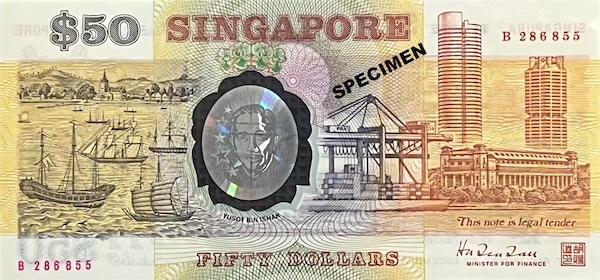
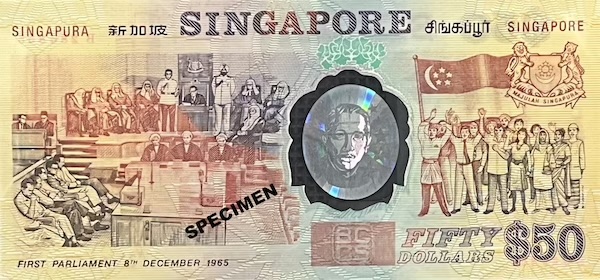
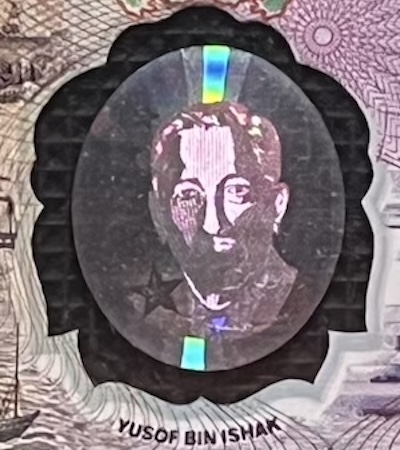
• Kinegram-like image of Yusof Ishak • Fluorescent ink • Intaglio print • Micro-lettering • Perfect registration of Vanda Miss Joaquim • Geometric patterns
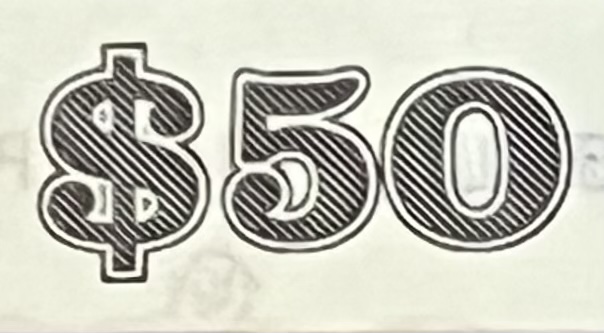
$50 was chosen over $25 even though it was our 25th anniversary, as $25 had proven to be an unpopular denomination in the Orchid series.
Our First Commemorative, And A Legacy of Firsts
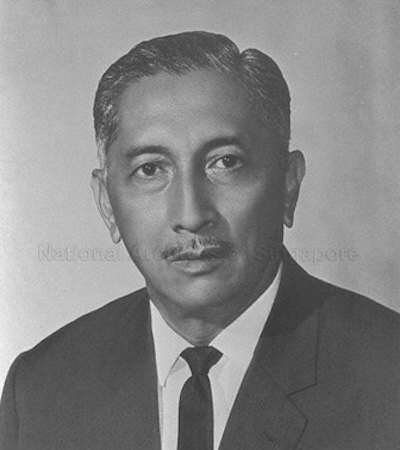
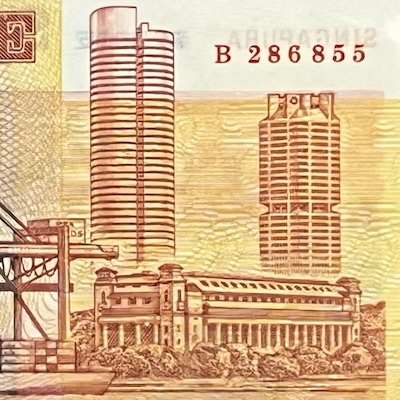
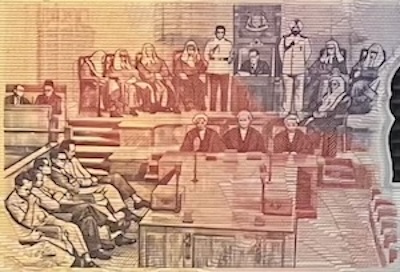
The 25th Anniversary $50 banknote was a note of many ‘firsts’. It was Singapore’s first-ever note issued to commemorate a historically significant milestone. It was our first polymer note, issued more than a decade before the Portrait Polymer notes. It was our first banknote to use a holographic image with a Kinegram-like security feature, which is difficult to counterfeit. It was the first of our banknotes to omit a security thread, an omission that will be also applied to several commemorative notes later. It was the first time a portrait of our late President Yusof Ishak was used on our banknotes, and his portrait would become the most dominant image to appear in our banknotes issued ever since. Finally, it was the first of our banknotes to be designed by a local artist, Mr Chua Mia Tee, whose signature appeared on the reverse side of the note, beside the man stood on the extreme right.
Yusof Ishak was our first President from 1965 to 1970. He played a crucial role in fostering our nation’s identity and racial harmony, advocating for equal opportunities for all races. He supported education and community-building policies, such as the establishment of the People’s Association in 1960, which promoted grassroots engagement and social cohesion. He also contributed to Malay-Muslim affairs and strengthened institutions that continue to serve the community up till today.
From Trading Port to Financial Hub
Singapore Harbour, 1961
Singapore River, 19893
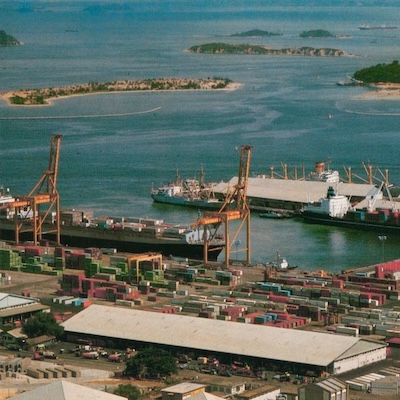
Tanjong Pagar Container Terminal, Late 1980s
Tanjong Pagar Container Terminal, 1980s4
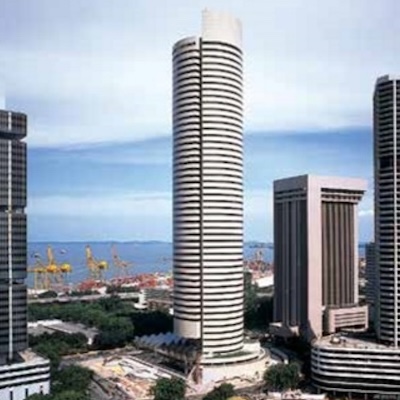
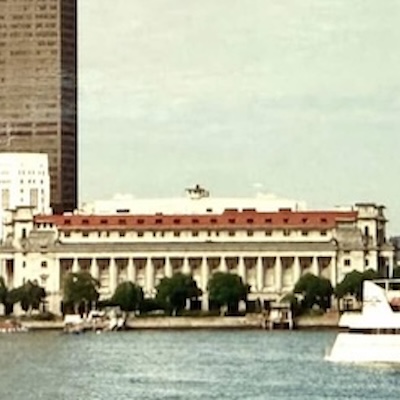
Treasury, Fullerton and DBS Buildings, Late 1980s
Treasury Building, 1990s5
Fullerton Building, 19896
DBS Building, 19807
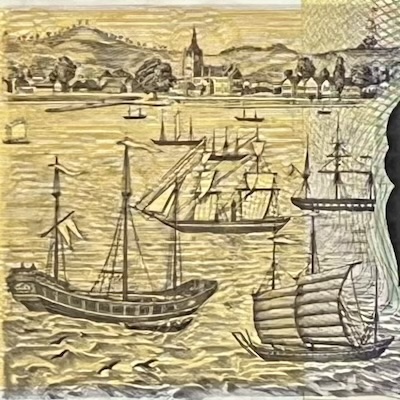
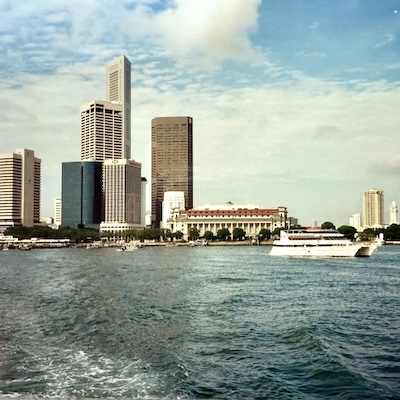
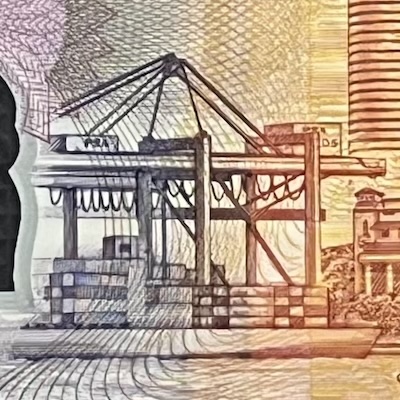
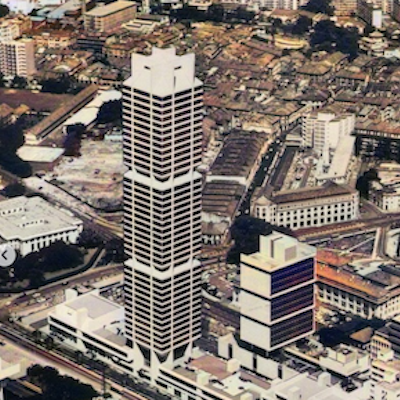
Singapore’s journey from a trading port in 1861 to a global financial hub in the 1990s is reflected through the changes along our waterfront. In 1861, the Singapore Harbour was full of wooden ships, small boats, and traders living along the river. Back then, trade relied mainly on human labour and traditional sailing ships. Over the years, these old settlements were replaced by tall office buildings. By the late 1980s, the same area where traders once worked had become our modern financial district, with important landmarks like The Fullerton, The Development Bank of Singapore, and The Treasury. Meanwhile, the evolution of the Tanjong Pagar Container Terminal showed how shipping continued to be important to Singapore, but now with advanced technology and container ships.
The Opening of Parliament and the Opposition That Walked Away
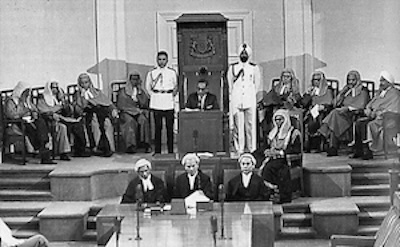
First Parliament in 1965
Singapore’s first parliamentary sitting took place on 8 December 1965 at The Old Parliament House. President Yusof Ishak delivered an opening address outlining the government’s priorities, including security, economic survival, and racial harmony. Prime Minister Lee Kuan Yew followed with a speech addressing the challenges of nation-building, emphasising the need for self-reliance, multiracialism, and economic development. This first session set the tone for Singapore’s parliamentary democracy and the foundation for key national policies in the areas of defence, economy, and social harmony.
First Parliament in 19658
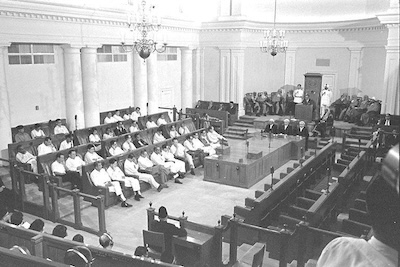
A day before this first Parliament sitting, the opposition party Barisan Sosialis announced they would boycott the session, accusing the People’s Action Party (PAP) of achieving ‘phoney independence’ through undemocratic means. None of their MPs attended, leaving the opposition benches empty. Lee Kuan Yew later called this a serious mistake, writing that ‘they deserted the political battlefield, leaving the PAP with no opposition in Parliament to challenge or question us.’ The boycott weakened Barisan Sosialis, leading to resignations and their eventual withdrawal from Parliament. This paved the way for PAP’s unchallenged dominance until an opposition MP was finally elected in 1981.
Opposition Boycott9
Some critics questioned the legitimacy of the first Parliament, as its members were elected in 1963 when Singapore was still part of Malaysia. With no fresh elections after independence, concerns arose over whether the government had a true mandate to lead a sovereign state. Barisan’s boycott also left PAP unchallenged in Parliament, raising worries about concentrated power. Still, the government swiftly amended constitutional references to Malaysia and began building the legal framework for an independent Singapore.
Market Value in 2024
Market Price: $75
Condition
• Ungraded
• Brand new
• No tears, pinholes, stains, foxing, creases or folds
Context
• The information here refers specifically to the banknote featured on the top of this page.
1. Prefix and banknote details from Vincent Tan and Tan Wei Jie, Singapore Banknotes: Complete Prefix Reference, Mr Banknotes, 2017.
2. Image from National Archives of Singapore. Source: https://www.nas.gov.sg/archivesonline/photographs/record-details/982925b6-1162-11e3-83d5-0050568939ad.
3. Image by Marion Perkins, Facebook. Source: https://www.facebook.com/photo/?fbid=614481447623568&set=pcb.3871610003094889.
4. Image from National Heritage Board. Source: https://www.roots.gov.sg/Collection-Landing/listing/1190572.
5. Image by Obayashi Singapore. Source: https://www.obayashi.com.sg/our-projects/treasury-building-temesak-tower/.
6. Image by Marion Perkins, Facebook. Source: https://www.facebook.com/photo/?fbid=614481447623568&set=pcb.3871610003094889.
7. Image from DBS, Facebook. Source: https://www.facebook.com/dbs.sg/posts/pfbid02vLmmEyoiD1mHqA7PEEMxCqx4zLjb91NyzqxHaXmijyr63APM6cLhJcBfZospxT2Ll.
8. Image from National Archives of Singapore. Source: https://www.nas.gov.sg/archivesonline/photographs/record-details/b4368ad7-1162-11e3-83d5-0050568939ad.
9. Image from National Archives of Singapore. Source: https://www.nas.gov.sg/archivesonline/photographs/record-details/c5624061-1161-11e3-83d5-0050568939ad.
Disclaimer
I built this website as a hobby, to share with others what I’ve learnt. All the information here is written based on my own research and understanding, and I don’t guarantee that everything is correct, complete, or updated. While I sell banknotes here, I don’t profit from them, as they are spare pieces from my private collection. All the banknote images here are taken by myself and they belong to me. The non-banknote images, with sources that I’ve attributed on every page, are used solely for illustration and non-commercial education purposes. If you are a copyright holder and believe something has been used inappropriately, please contact me, and I will immediately review or remove it.