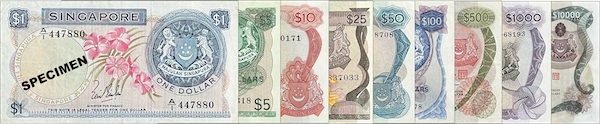
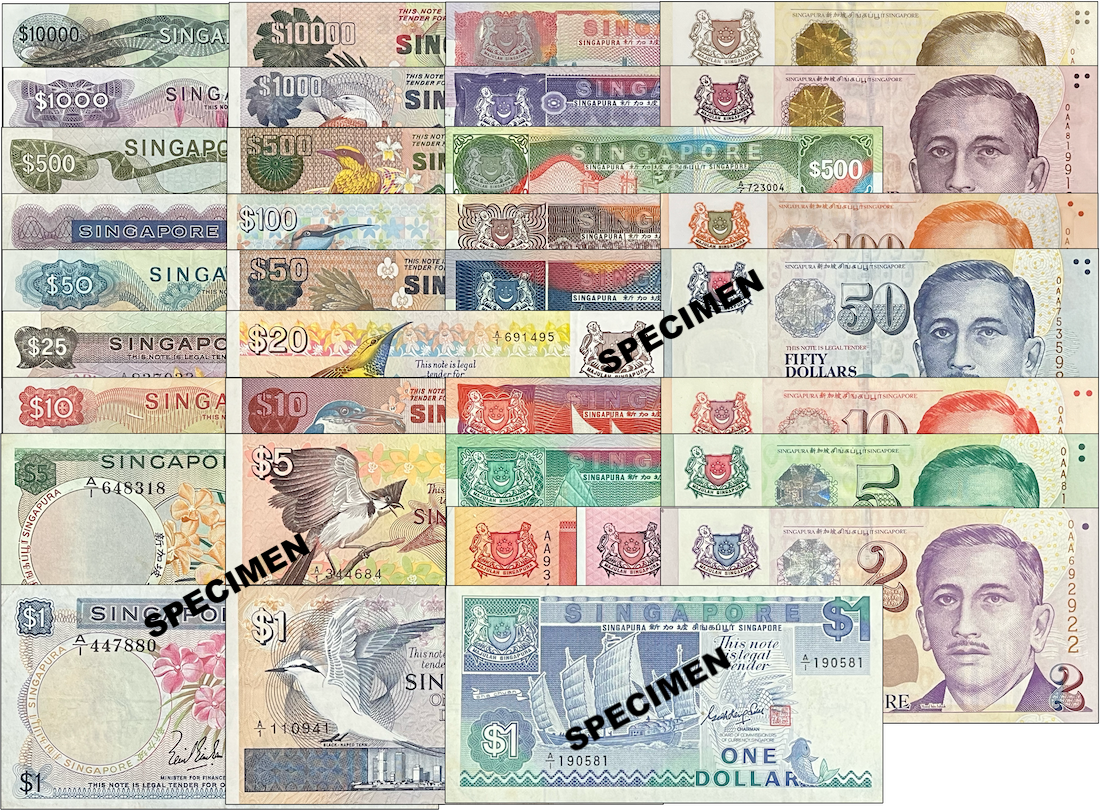
Banknotes are printed in different colours so people can tell them apart easily. Each denomination has its own colour, so we don’t need to read the numbers every time. This helps everyone transact more quickly, especially the people who have trouble seeing clearly.
All Circulation Notes
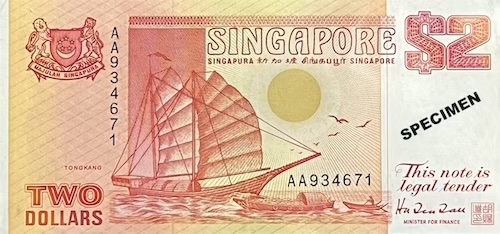
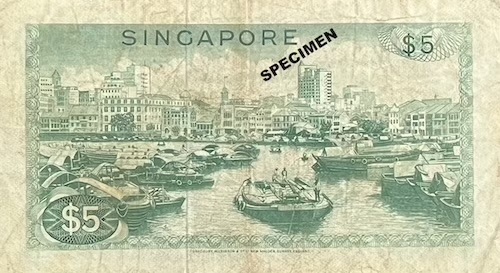
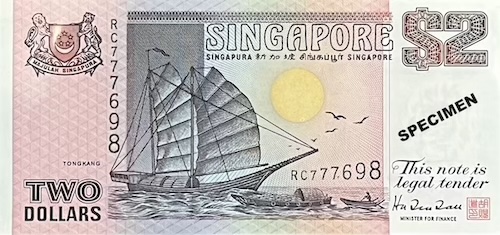
Colours are usually kept the same across different banknote series, because people are already familiar with them, and it makes things easier when switching to a new series. In fact, many of the colour choices go back to colonial times. The British-era notes used blue for $1, green for $5, red for $10, blue for $50, grey for $100, purple for $1000, and green for $10000. When Singapore issued our own Orchid series, our government kept most of these colours, with only minor changes: the $100 became a bit more bluish than grey, and two new notes were added—$25 in brown and $500 in light green. The Bird series followed the same colours, except the $20 was changed from brown to yellow. In the Ship series, some colours were adjusted. The $2 note was introduced in orange but was later changed to purple because people confused it with the red $10 note. The $100 took on a brown colour, which was previously used for the discontinued $25 note. The $10000 note changed from green to red to avoid confusion with the green $500 note—this distinction was needed because the $10000 note was now smaller and closer in size to the $500. In the Portrait series, the $100 changed again—this time to an orange-yellow shade instead of brown, while the $10000 note was re-coloured gold to reflect its status as the highest denomination. With these changes, the only denominations today that retained their original colours are: $2, $5, $10, and $1000. Commemorative notes don’t follow these colour rules as they’re meant as collectibles and not for daily use.
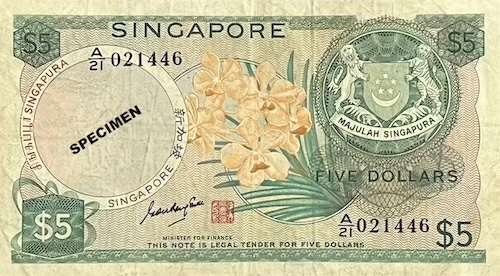
O5: Yellow Paper
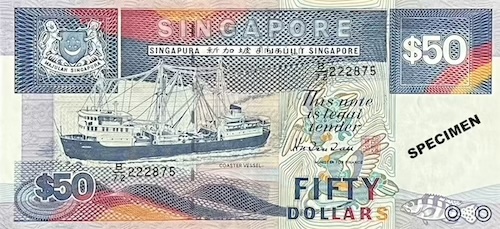
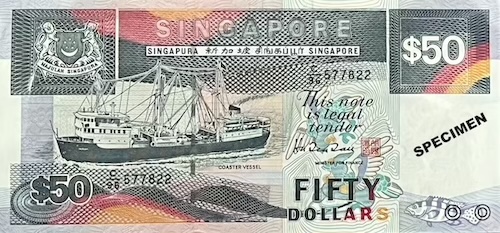
S50: Light and Dark Blue
P2: Orange and Purple Notes
There were a few unusual cases. Some Orchid $5 and $25 notes were printed on “yellow paper” that had a strange yellow tint. No one knows exactly why—maybe it was due to the materials used, the way the paper aged, or less strict quality control at the time. The Ship $50 note is the only one in Singapore’s history that came in two shades of the same colour: light blue and dark blue. The light blue version used a solid or segmented security thread, while the dark blue version used a clear-text thread—but it’s not known why the colours had to be different. The Ship $2 note is also unique—it came in two completely different colours. As mentioned earlier, the first version was orange, but because people kept mistaking it for the red $10, it was replaced with a purple version. No other Singapore note has ever had two such different colour versions.
Disclaimer. I built this website as a hobby, to share with others what I’ve learnt. All the information here is written based on my own research and understanding, and I don’t guarantee that everything is correct, complete, or updated. While I sell banknotes here, I don’t profit from them, as they are spare pieces from my private collection. All the banknote images here are taken by myself and they belong to me. The non-banknote images, with sources that I’ve attributed on every page, are used solely for illustration and non-commercial education purposes. If you are a copyright holder and believe something has been used inappropriately, please contact me, and I will immediately review or remove it.