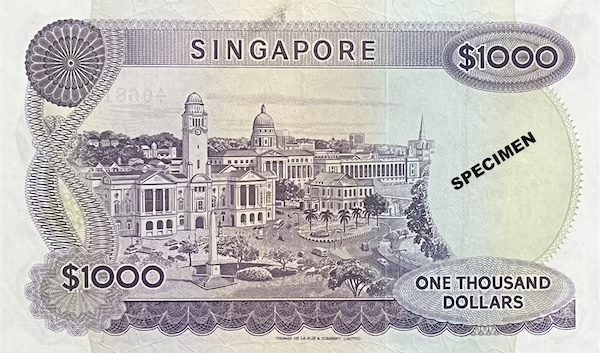
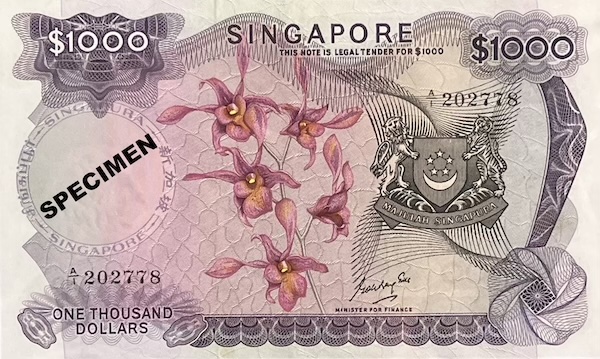
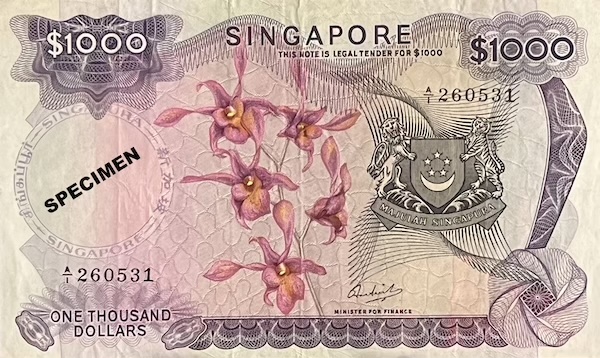
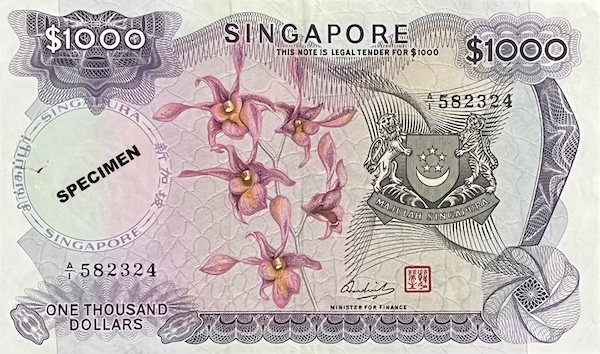
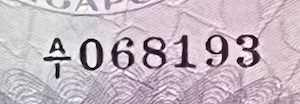
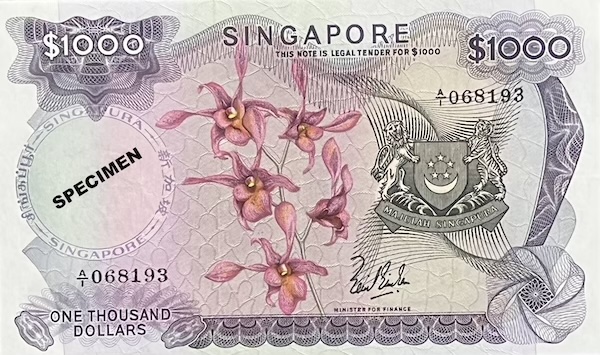
Orchid $1000 (1967)

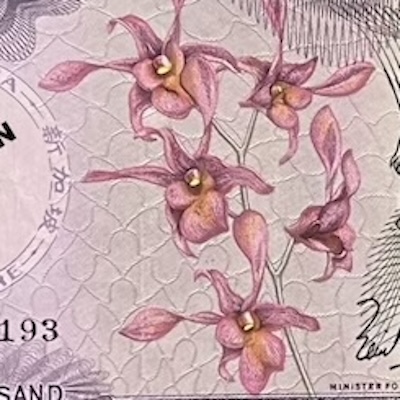
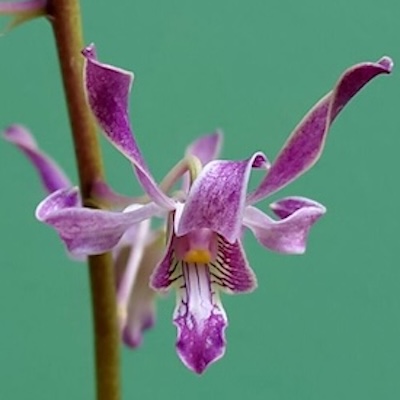
Orchid: Dendrobium Kimiyo Kondo 'Chay'
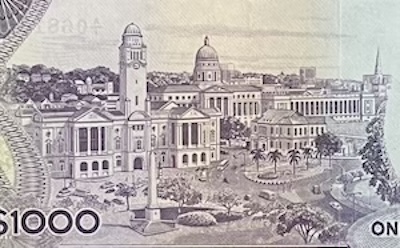
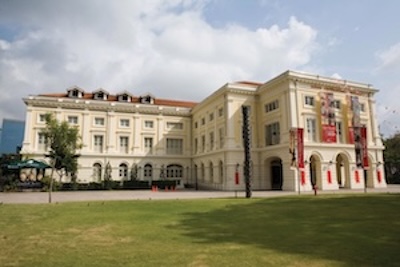
Image: Victoria Theatre and Empress Place

Where Art and Community Came Alive

Victoria Theatre and Empress Place were our cultural havens. These grand old dames were the heartbeats of our artistic and cultural expression, hosting a range of performances and gatherings. Every day, families strolled through the area, street vendors offered local delicacies, and artisans showcased their crafts. Amid the toils of the early years, this was a venue where we gathered and sat back to watch plays, concerts and performances that stirred our hearts and ignited our imaginations.

Circulation status: Discontinued

Issuing authority: BCCS

First issued: 12 June 1967

Pieces issued: 0.6 million

Printer: Thomas De La Rue & Co Ltd

Material: Paper

‘Singapore’ in caps

‘Singapore’ in four languages

National Coat of Arms

Orchid: Dendrobium Kimiyo Kondo ‘Chay’ (front)  
Image: Victoria Theatre & Empress Place (back)

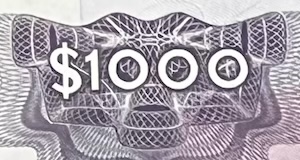
Denomination print: ‘$1000’ & ‘ONE THOUSAND DOLLARS’ 

Size: 159mm x 95mm

Colour: Purple

Guarantee: Legal tender affirmation

First prefix: A1

Last prefix: A1

Replacement prefix: Z1

Signed by: Minister for Finance

A1: Lim Kim San (no seal)

A1: Goh Keng Swee (no seal)

A1: Hon Sui Sen (no seal)

A1: Hon Sui Sen (with seal)

Z1: Hon Sui Sen (with seal)

Watermark of lion’s head

Fluorescent ink

One solid, vertical security thread

Intaglio print

Geometric patterns

Signed by: Lim Kim San (No Seal)
Signed by: Goh Keng Swee (No Seal)
Signed by: Hon Sui Sen (No Seal)
Signed by: Hon Sui Sen (With Seal)

The Curious Case of The Orchid $1000

Throughout all series of Singapore’s banknotes, the higher denomination is always physically larger or at least identical to the lower denominations of the same series. This is a feature to make it easier to identify the banknotes. The Orchid $1000 is the only exception: it is marginally smaller than the $500, and the same size as the $100, for reasons unknown. This is particularly puzzling given that this note was issued together with the first batch of denominations issued and therefore it couldn’t have been an after-thought; and there was an ever larger $10000 note issued later and therefore it couldn’t have been a size constraint. In addition, there’s also another uniqueness about the Orchid $1000: it is the only banknote in Singapore’s history to feature a single cross-over prefix—A1—with four variants, each having a different signature-seal combination. This uniqueness is easier to explain: fewer than 1 million pieces of $1000 notes were issued, and therefore the prefix didn’t have to exceed A1. 

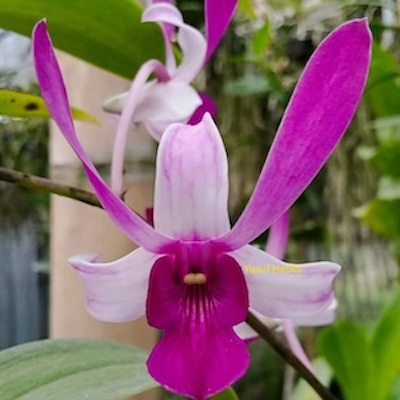
Dendrobium Kimiyo Kondo 'Chay'
Dendrobium Kimiyo Kondo3
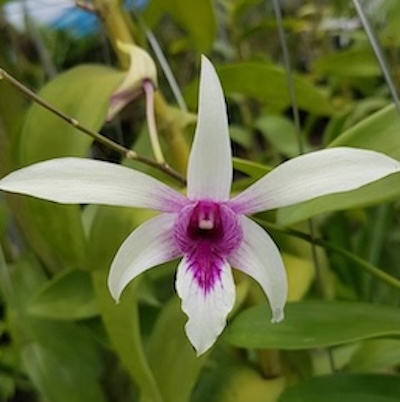
Dendrobium Caesar (Seed Parent)4
Dendrobium Gouldii (Pollen Parent)5

Genus: Dendrobium 

Grex: Kimiyo Kondo

Cultivar: Chay 

Registrant: Kondo   

Originator: J.K.Noa (1953)

Dendrobium is one of the largest groups of orchids, with over 1,500 species that range from tiny plants to big, colourful blooms. They are easy to grow and loved by many people around the world, whether in homes, gardens, or flower shows. In the orchid world, it’s common to name new hybrids after people who have made important contributions—in areas like culture, diplomacy, or orchid growing. Not much is known about Kimiyo Kondo, but she was likely someone important, possibly linked to the orchid industry or diplomatic circles. The orchid named after her, Dendrobium Kimiyo Kondo, is rarely seen in nurseries today. This makes it especially valuable among collectors who look for older or vintage orchid hybrids.

From Town Hall to Theatre: The Story of Victoria’s Grand Duo

Victoria Theatre and Empress Place

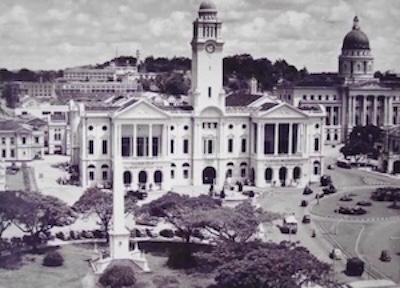
Victoria Theatre and Victoria Concert Hall are two buildings often mistaken as one. The Victoria Theatre was first built in 1862 as a Town Hall, used for meetings and performances. Later, in 1905, a new building called Victoria Memorial Hall was added next to it to honour the death of Queen Victoria. Over time, the two buildings were joined together and are now known as Victoria Theatre and Concert Hall.

Victoria Theatre and Empress Place in 1960s6

During the Japanese Occupation, Victoria Theatre was taken over by the Japanese military. Instead of hosting local shows or music, it was used for military events and propaganda programmes. The Japanese used it to spread their message and show their control over Singapore. It became a place where Japanese culture and rule were promoted to the public.

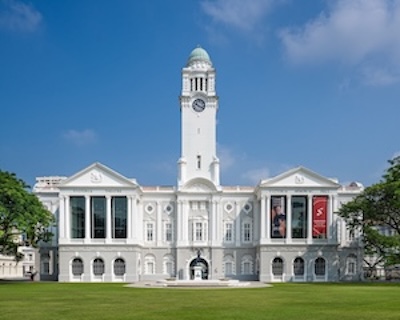
Victoria Theatre and Concert Hall Today7

After the war, Victoria Theatre became a place where important political speeches and rallies were held. It was often used by leaders such as Lee Kuan Yew, who gave many public speeches there during the time Singapore was working towards self-governance. The theatre played a big role in the country’s early political history, as it was where many people gathered to hear about Singapore’s future.

Empress Place Building Today8

Today, Victoria Theatre and Empress Place are well-preserved landmarks in the heart of Singapore. The theatre still hosts concerts, plays, and cultural events, while keeping its old design. Empress Place is now an area with museums like the Asian Civilisations Museum, open spaces, and views of the Singapore River. Both places are popular spots where people come to enjoy the arts, learn about history, and spend time together.

Market Value in 2024

Market Price: $2,100

Condition

• Ungraded

• Lightly used

• No tears, pinholes, stains or foxing

• Light creases & folds 

Context  

• The information here refers specifically to the banknote featured on the top of this page.

• The same note may fetch a higher price if it is graded, in superior condition, has special serial numbers or other special prefixes, or is a specimen or error note.

• The same note may fetch a lower price if it is in poorer condition.

Attributions

1. Prefix and banknote details from Vincent Tan and Tan Wei Jie, Singapore Banknotes: Complete Prefix Reference, Mr Banknotes, 2017

2. Orchid registration details from International Orchid Register

3. Image by Yusuf Habibi. Source: https://orchidroots.com/display/summary/orchidaceae/100059467/.

4. Image from OrchidRoots. Source: https://www.orchidroots.com/display/summary/orchidaceae/100047983/.

5. Image by Anggrek Rahayu. Source: https://www.orchidroots.com/display/summary/orchidaceae/101047556/.

6. Image by Low Kam Hoong. Source: https://thelongnwindingroad.wordpress.com/2010/07/09/the-raffles-walkabout/.

7. Image by Richie Chan. Source: https://www.timeout.com/singapore/music/vchpresents-organ-pipe-up-ii.

8. Image from National Heritage Board. Source: https://www.researchgate.net/figure/Former-Empress-Place-Building-now-Asian-Civilisations-Museum-Source-National-Heritage_fig7_376598904. 

Disclaimer
I built this website as a hobby, to share with others what I’ve learnt. All the information here is written based on my own research and understanding, and I don’t guarantee that everything is correct, complete, or updated. While I sell banknotes here, I don’t profit from them, as they are spare pieces from my private collection. All the banknote images here are taken by myself and they belong to me. The non-banknote images, with sources that I’ve attributed on every page, are used solely for illustration and non-commercial education purposes. If you are a copyright holder and believe something has been used inappropriately, please contact me, and I will immediately review or remove it.
Shudoo: [email protected] 
Shopping Basket