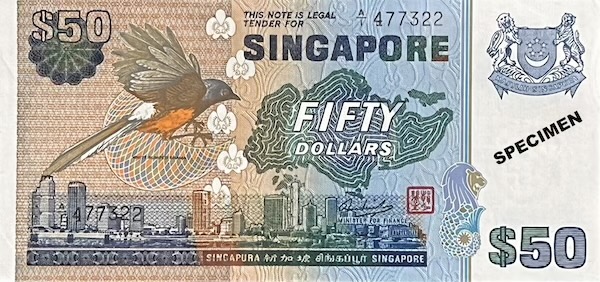
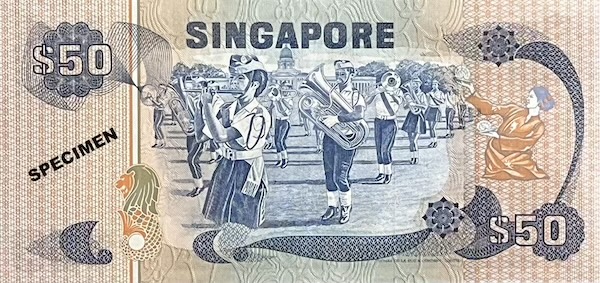
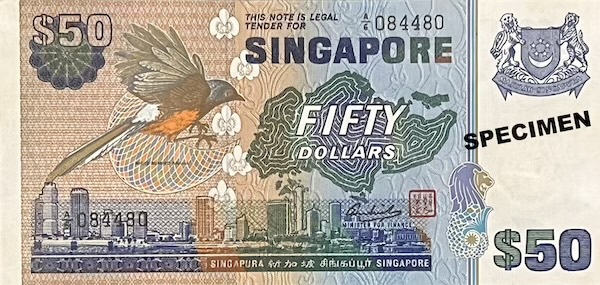
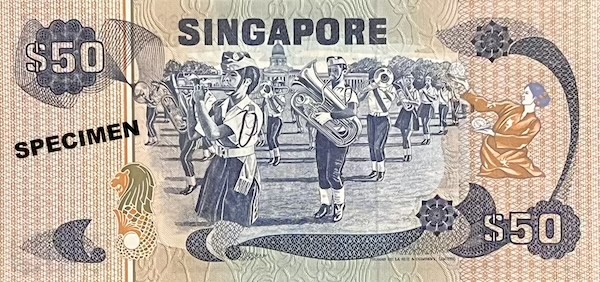
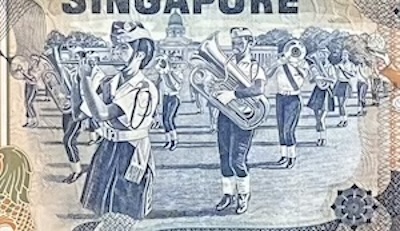
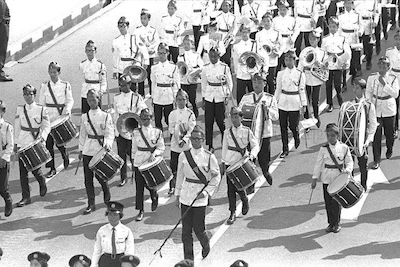
School bands were a common sight during parades and national events. Every beat of their drums, and every note of their trumpets, echoed the rhythm of our nation’s heartbeat. These young musicians represented the best of our values–teamwork, discipline, and patriotism. The sight and sound of students in crisp uniforms, marching in unison, filled us with immense pride in our journey, and unwavering confidence in our future.
One vertical security thread • Prefix A1 to A5: Solid thread • Prefix A6 to B49: Segmented thread
• Prefix Z1: Solid/segmented thread
• Prefix Z2: Segmented thread
Intaglio print
Perfect registration of Merlion
Geometric & floral patterns
Solid Security Thread (Front)
Segmented Security Thread (Front)
Solid Security Thread (Back)
Segmented Security Thread (Back)
The Merlion Makes Its Mark
Together with the Bird $10, the $50 note is special because it was the first time the Merlion appeared on Singapore’s banknotes. The Merlion was introduced in 1972 as a national symbol to help promote tourism, and it quickly became a well-known icon of Singapore. When the Bird Series was launched in 1976, the $10 and $50 notes were among the first batch of denominations to be released. Including the Merlion in the design of these notes was a meaningful way to showcase our identity to the rest of the world.
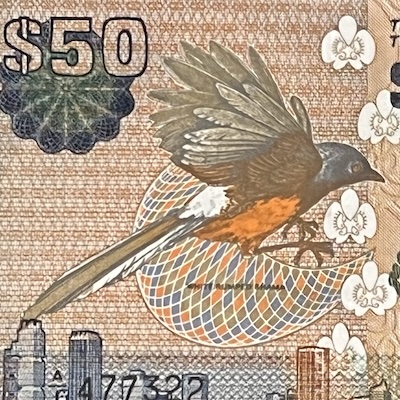
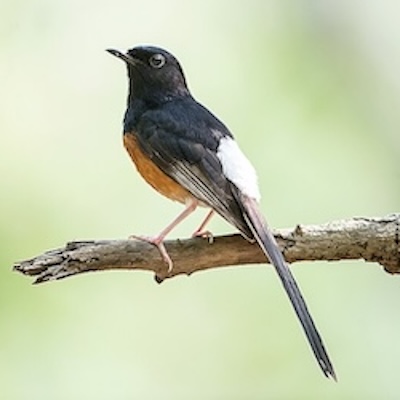
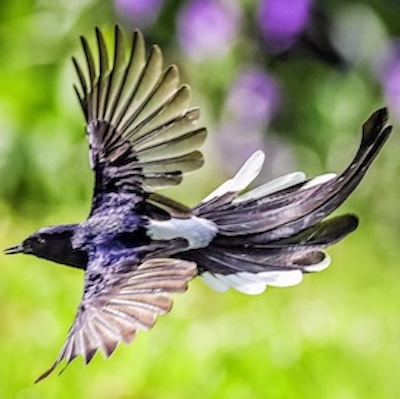
The White-rumped Shama is a beautiful songbird about 25cm long, found from India to Southeast Asia. In Singapore, it lives in forests and wooded areas like Pulau Ubin, Pulau Tekong, and the Central Catchment Nature Reserve. The male has shiny blue-black feathers, orange underparts, a white rump, and a long tail. The female looks similar but is grey and has a shorter tail. This bird sings well and searches for food on the ground among leaves. Though common in the region, it is critically endangered in Singapore due to trapping for the pet trade. Birdwatchers love it for its striking looks and sweet, rich calls.
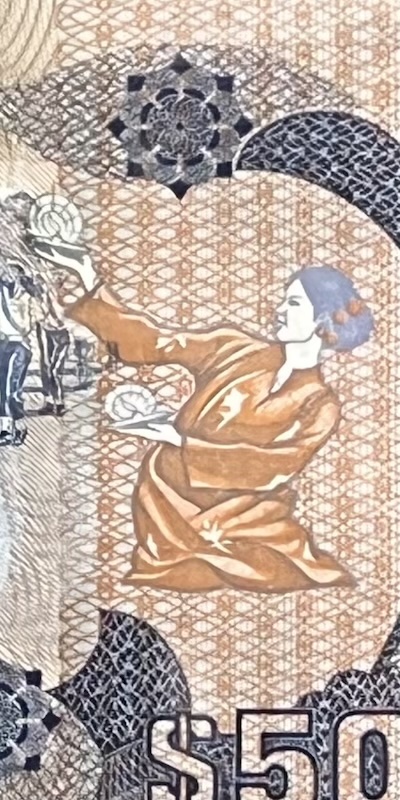
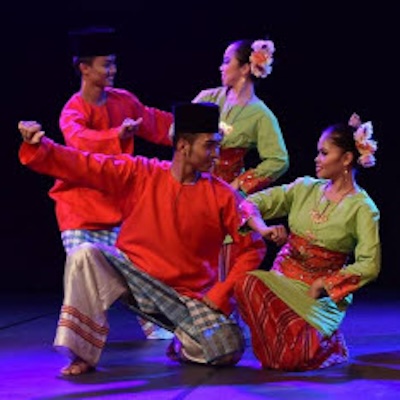
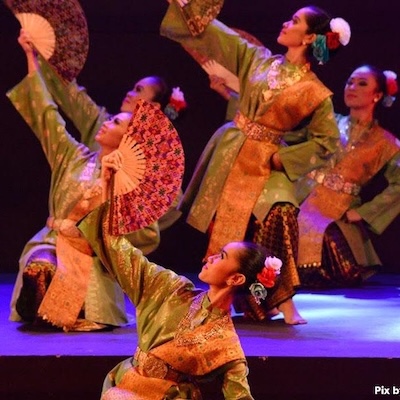
The Zapin is a traditional Malay dance often performed at cultural festivals, weddings, and state events like National Harmony Day. The dance features graceful, synchronised movements with intricate footwork, as dancers move in lines or circles to music that shifts between slow and fast tempos. In the 1970s, schools and community centres offered Zapin dance classes to help preserve Malay cultural traditions, while the People’s Association included Zapin performances in their activities to promote racial harmony and cultural appreciation.
When School Bands Led the Way
School Band
In the 1970s, the Singapore government encouraged schools to form bands to help students build teamwork, discipline, and national pride. This move was part of a bigger effort to shape a strong sense of identity and unity among young people during a key period of nation-building.
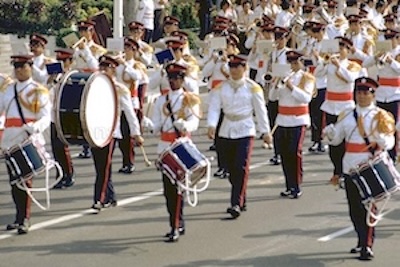
SAF Band on Parade in 19727
At that time, many school bands were influenced by military-style marching bands, especially those from the British tradition. Singapore was moving away from its colonial past, and schools often modelled their bands after the Singapore Armed Forces Band, which became the gold standard for precision and performance.
Combined Schools Band in 1969 NDP Rehearsal8
Back then, with fewer entertainment choices than today, school bands had a more visible role in community life. They often performed at public events like National Day Parades and neighbourhood celebrations. These performances not only showcased students’ talents but also helped grow a shared sense of pride in Singapore’s progress.
Market Value in 2024
Market Price: $140
Condition
• Ungraded
• Lightly used
• No tears, pinholes, stains or foxing
• Minor creases & folds
Context
• The information here refers specifically to the banknote featured on the top of this page.
1. Prefix and banknote details from Vincent Tan and Tan Wei Jie, Singapore Banknotes: Complete Prefix Reference, Mr Banknotes, 2017.
2. Information about birds from Yong Ding Li and Lim Kim Chuah, A Naturalist’s Guide to the Birds of Singapore, 2016; and Birds of Singapore, https://singaporebirds.com.
3. Image by Koshy Koshy. Source: https://commons.wikimedia.org/wiki/File:White-rumped_Shama_(14503818154).jpg.
4. Image by Lam Le, Facebook. Source: https://www.facebook.com/photo/?fbid=4026591194285253&set=gm.3924950347786787&idorvanity=1575054229443089.
5. Image by Discovery Overland Holidays. Source: http://www.discoveryoverland.com/html/details.aspx?ID=4&PID=25&NID=165&Type=Events.
6. Image by A Hamid Halim. Source: https://jalurgemilangrecords.com/exploring-the-origins-and-evolution-of-zapin-dance/.
7. Image from National Archives of Singapore. Source: https://www.nas.gov.sg/archivesonline/photographs/record-details/36c518d2-1162-11e3-83d5-0050568939ad.
8. Image from National Archives of Singapore. Source: https://www.nas.gov.sg/archivesonline/photographs/record-details/cf36b8df-1161-11e3-83d5-0050568939ad.
Disclaimer
I built this website as a hobby, to share with others what I’ve learnt. All the information here is written based on my own research and understanding, and I don’t guarantee that everything is correct, complete, or updated. While I sell banknotes here, I don’t profit from them, as they are spare pieces from my private collection. All the banknote images here are taken by myself and they belong to me. The non-banknote images, with sources that I’ve attributed on every page, are used solely for illustration and non-commercial education purposes. If you are a copyright holder and believe something has been used inappropriately, please contact me, and I will immediately review or remove it.