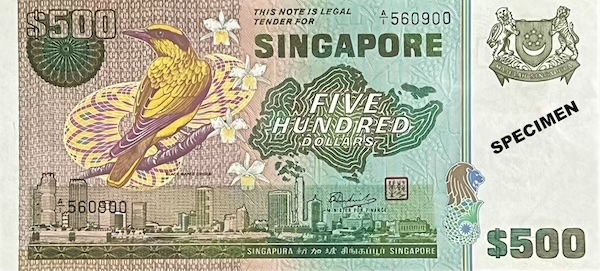
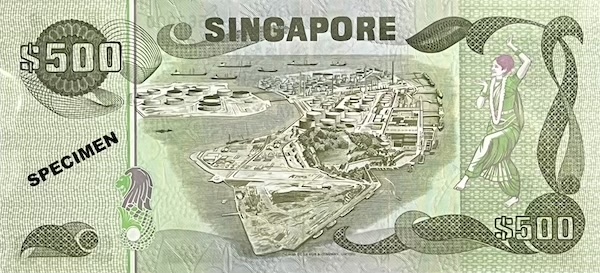
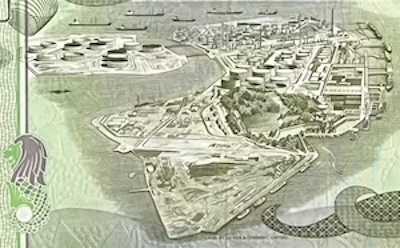
Pulau Bukom was a cornerstone of our industrial journey, marking Singapore’s transformation from a small port city to a thriving hub of industry. The oil refinery wasn’t just about fuel–it was about our nation’s leap into the future. It provided jobs and opportunities, transforming lives and boosting our economy. In the day, its towering structures and constant hum of activity were a testament to our ambition and determination. In the night, its flickering lights served as our beacon of progress and hope.
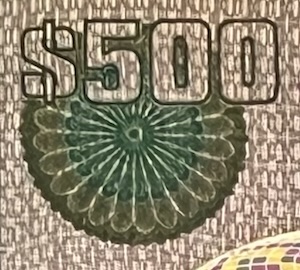
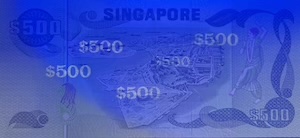
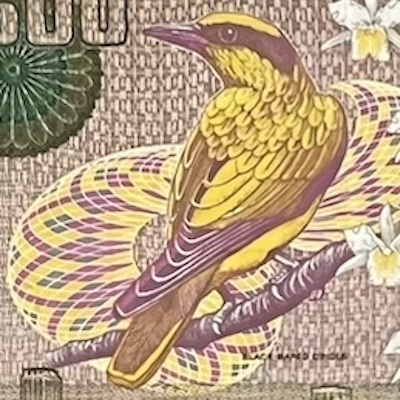
The Bird $500 note together with the Bird $100, both released on 1 February 1977, were the first Singapore banknotes to include ultraviolet (UV) text—words or numbers that can only be seen under UV light. For example, when the Bird $500 note is placed under UV light, the hidden ‘$500’ appears. This was a new security feature added to help prevent counterfeit notes—a technologically advanced way to make our money safer. After this, all of Singapore’s banknotes in the Bird, Ship and Portrait series included this feature, except for the Ship $1 and $2 notes.
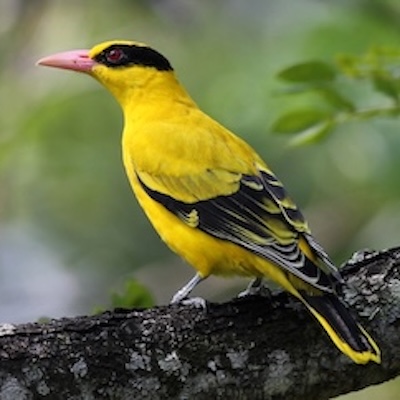
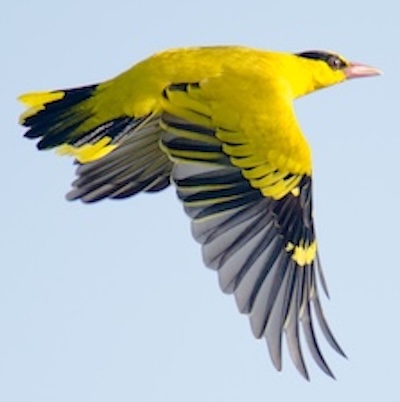
The Black-naped Oriole is the only oriole found in Singapore. It is easy to recognise with its bright yellow body, black stripe across the eyes and back of the head, red eyes, and pink beak. Males are especially colourful, with rich golden-yellow feathers. Most of their wings are black, though some may have yellow edges depending on the type. This medium-sized bird is very common and can be seen all over Singapore in parks, forests, mangroves, old plantations, and scrubland. It eats both fruits and insects, and sometimes joins other birds in trees with lots of fruit. You can spot it in places like Bukit Timah Nature Reserve, Central Catchment, Dairy Farm, and Kent Ridge Park. The bird lives in Singapore all year round and is not under any threat.
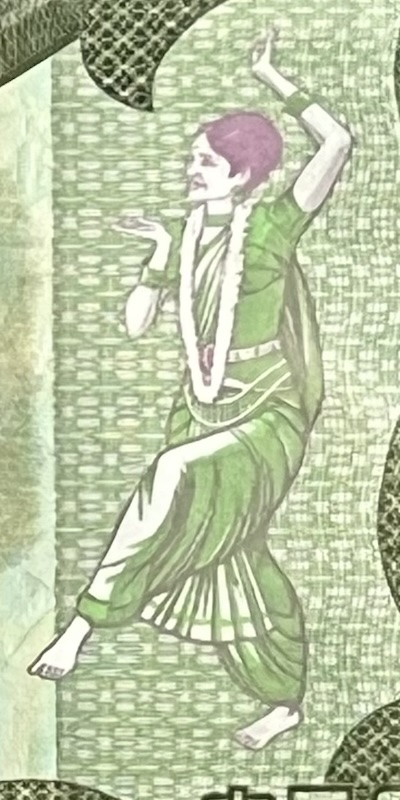
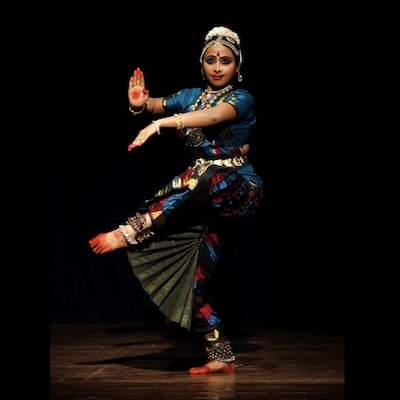
Bharatanatyam is a classical dance from South India, known for its precise steps, expressive hand movements (called mudras), and strong storytelling. The name itself is a portmanteau of four Tamil words—bhavam (expression), ragam (melody), thalam (rhythm), and natyam (dance). Dancers wear a costume that looks like a sari, along with beautiful jewellery and flowers in their hair. The dance mixes graceful body movements, strong footwork, and clear facial expressions to tell stories from Hindu mythology. In Singapore, Bharatanatyam is taught and performed widely within the Indian community. Schools like the Singapore Indian Fine Arts Society and Apsaras Arts help to keep this dance tradition alive.
Pulau Bukom: A Tale of Fuel, Families, Fires, and the Future
Pulau Bukom
Pulau Bukom, operated by Shell, was established in 1961 as the first oil refinery in Singapore. By the 1970s, it had become a vital part of Singapore’s industrial economy, helping to power the country’s growth. At that time, Pulau Bukom functioned as an ‘island city’, a self-sufficient island with its own power plants, desalination systems, and housing facilities. In those days, workers and their families lived on-site, creating a tight-knit community on the island, complete with recreational facilities and schools.
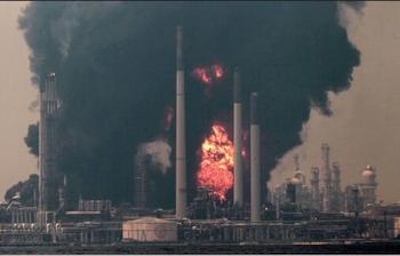
Fire at Pulau Bukom in 20117
Pulau Bukom has had a number of serious incidents over the years. In 1985, an explosion happened during maintenance work, causing fires to spread across nearby parts of the refinery and injuring several workers. In 2011, a major fire broke out in a pump-house used for refining crude oil. It burned for 55 hours and took 32 firefighting vehicles and over 100 firefighters to bring under control. More recently, in October 2024, an oil leak occurred during routine maintenance, raising concerns about pollution and how well such spills are managed.
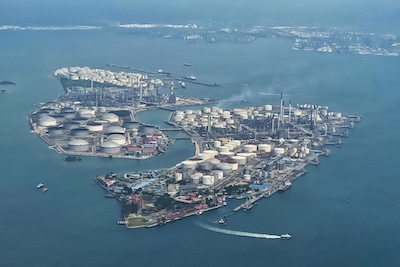
Pulau Bukom Today8
Over the decades, Shell has expanded the Pulau Bukom site into a major manufacturing and export hub for fuels and chemicals. However, as global energy needs shifted and Shell moved towards cleaner and more sustainable businesses, the company began scaling down its refining operations. In May 2024, Shell announced it would sell the Pulau Bukom refinery. This marked the end of an era for one of Singapore’s most iconic industrial sites.
Market Value in 2024
Market Price: $630
Condition
• Ungraded
• Well used
• No tears, pinholes or foxing
• One soft stain & pen marking
• Visible creases & folds
Context
• The information here refers specifically to the banknote featured on the top of this page.
1. Prefix and banknote details from Vincent Tan and Tan Wei Jie, Singapore Banknotes: Complete Prefix Reference, Mr Banknotes, 2017.
2. Information about birds from Yong Ding Li and Lim Kim Chuah, A Naturalist’s Guide to the Birds of Singapore, 2016; and Birds of Singapore, https://singaporebirds.com.
3. Image by Nick Dean@Nick dean1, Flickr. Source: https://www.flickr.com/photos/44691276@N06/7943597898.
4. Image from Shanghai Birding. Source: https://www.shanghaibirding.com/tag/black-naped-oriole/.
5. Image by Vivekh 1979, Wikipedia. Source: https://commons.wikimedia.org/wiki/File:Murugashankari_Leo.jpg.
6. Image by Sivavkm, Wikipedia. Source: https://commons.wikimedia.org/wiki/File:Rajasree_warrier_IMG_7539.JPG.
7. Image from China.Org.Cn. Source: http://www.china.org.cn/environment/2011-09/30/content_23530040.htm.
8. Image from The Straits Times. Source: https://www.straitstimes.com/business/indonesian-buyer-expects-big-revenue-boost-from-shell-s-assets-on-pulau-bukom-and-jurong-island.
Disclaimer
I built this website as a hobby, to share with others what I’ve learnt. All the information here is written based on my own research and understanding, and I don’t guarantee that everything is correct, complete, or updated. While I sell banknotes here, I don’t profit from them, as they are spare pieces from my private collection. All the banknote images here are taken by myself and they belong to me. The non-banknote images, with sources that I’ve attributed on every page, are used solely for illustration and non-commercial education purposes. If you are a copyright holder and believe something has been used inappropriately, please contact me, and I will immediately review or remove it.