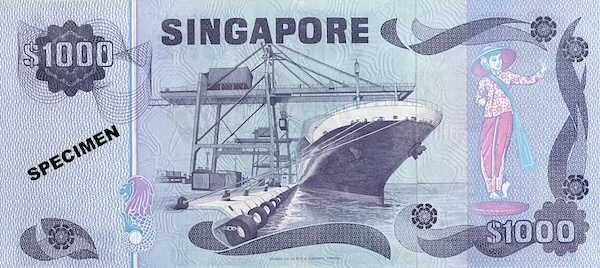
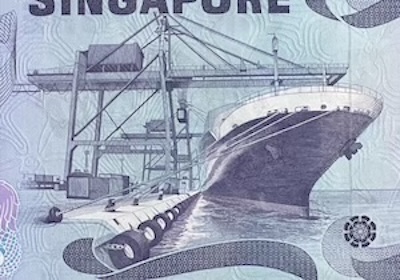
The Container Terminal of the Port of Singapore Authority was more than just a piece of infrastructure—it was a powerful symbol of our nation’s ambition and progress. It allowed our small island nation to establish a strong presence in global trade. With massive container ships docking daily and towering cranes operating with precision and speed, every container that passed through played a role in driving our economy forward. The terminal helped transform our port into one of the busiest and most efficient in the world, proudly reflecting our commitment to connectivity, innovation, and global excellence.
Two vertical security threads: one solid & one segmented
Intaglio print
Perfect registration of Merlion
Ultraviolet-visible text
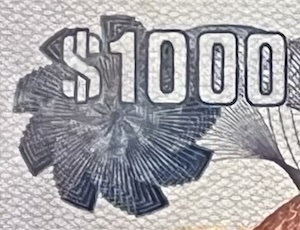
Geometric & floral patterns
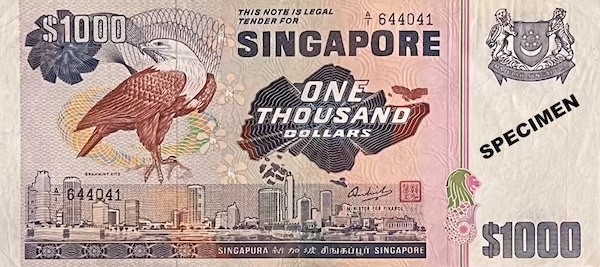
The Note With the Broadest Wings
The Bird $1000 stands out for its impressive size and an enhanced security feature. Aside from the Orchid and Bird $10000 notes, it is the widest banknote ever issued in Singapore’s history. At 197mm in width, it is even broader than the $10000 notes from the Ship Series (195mm) and the Portrait Series (180mm). Its unusual size is so significant that professional grading services will charge an additional fee to process it. Adding to its uniqueness, the Bird $1000 is one of only three Singapore banknotes to include two security threads—a rare feature shared only with the Orchid $10000 and Bird $10000 denominations.
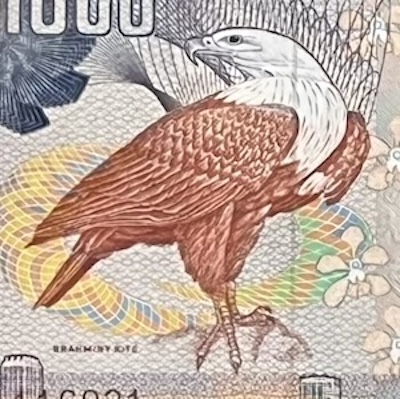
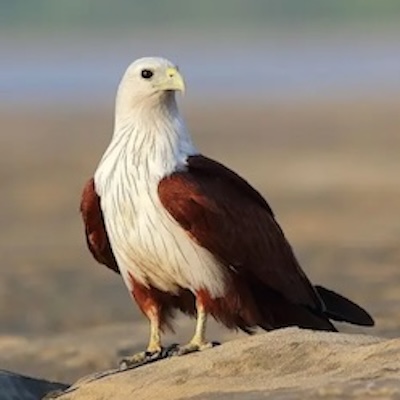
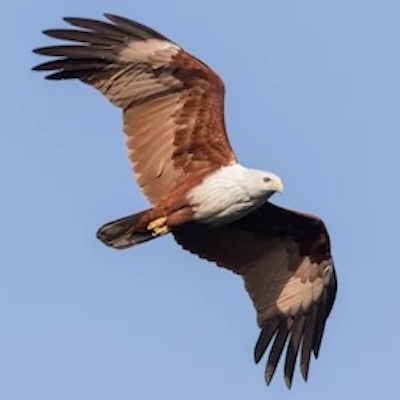
The Brahminy Kite is a medium-sized raptor, about 44–52 cm long, and is one of the most commonly seen birds of prey in Singapore. It is easy to recognise with its white head and chest, contrasting with its rich reddish-brown body and wings. When flying, its wings form a distinct “M” shape, making it easy to identify in the sky. It is usually found near coasts, rivers, and mangroves, but is also often seen flying over parks, reservoirs, and urban areas like Jurong Lake. On some islands, like Coney Island, it can be seen gathering in large groups to roost. The Brahminy Kite feeds mainly on fish but also scavenges for dead animals, often picking up scraps along the shoreline. Its call is rather unusual, sometimes compared to a whining baby. This bird is a year-round resident in Singapore and is also found across the Indian subcontinent, Southeast Asia, and as far as Australia.
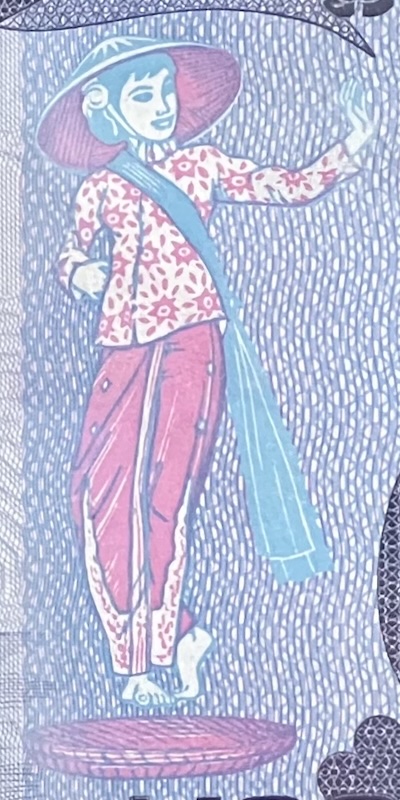
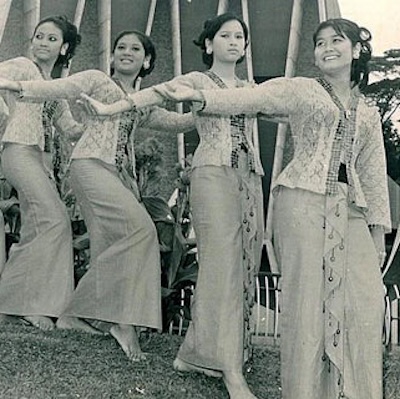
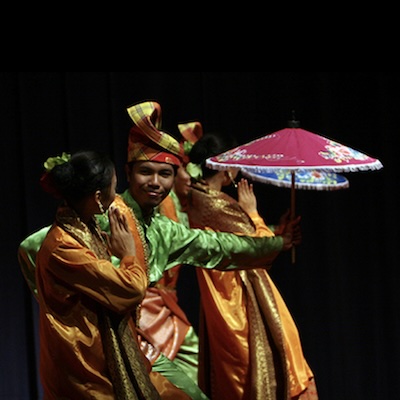
The Joget is a lively traditional Malay folk dance often performed at weddings, cultural festivals, and community events. Inspired by kampong life, it reflects the spirit of village living, where people worked the land and lived closely together. Dancers wear batik-style costumes and sometimes use long scarves to enhance the smooth, flowing movements. Props like straw hats and woven baskets add colour and highlight scenes from daily life, such as farming or food gathering. Joget features cheerful, rhythmic steps performed in pairs or groups, and was especially popular in 1970s Singapore at school functions and community celebrations.
A Big Bet on Containers That Paid Off
PSA Container Terminal
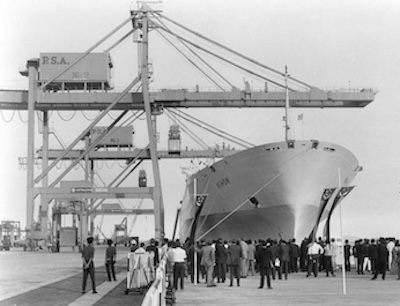
In 1972, Singapore opened the Tanjong Pagar Terminal, the first container terminal in Southeast Asia. At that time, container shipping was still a new idea. Many countries in the region were still using older ways like breakbulk shipping, where goods were packed and moved one by one in sacks, boxes, or barrels. This method was slow and took a lot of effort. Even though containers were faster and more efficient, many people were unsure if the idea would catch on in this part of the world. Still, PSA took the risk early, and that decision gave Singapore a strong head start. It helped us become one of the top shipping centres in the world.
PSA Container Terminal in 19727
Singapore has been a free port since colonial times, which means traders didn’t have to pay taxes or tariffs to bring goods in. This made Singapore more attractive than other ports in the region that had stricter trade rules. In the 1970s, this free port policy made the new PSA Container Terminal even more appealing to global shipping companies. It allowed goods to be stored, sorted, or sent elsewhere without high costs, helping the terminal grow quickly and become a key part of global trade.
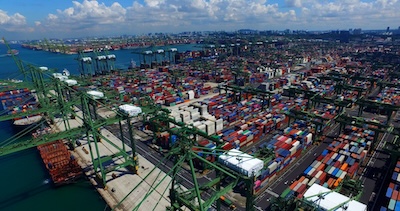
PSA Container Port Today8
PSA’s container terminal in the 1970s laid the groundwork for Singapore’s transformation into one of the busiest and most advanced ports globally. It showed that Singapore was ready to adopt new technology and keep up with changes in global trade, even at an early stage.
Market Value in 2024
Market Price: $1,200
Condition
• Ungraded
• Well used
• No tears, pinholes, stains or foxing
• Light folds & creases
Context
• The information here refers specifically to the banknote featured on the top of this page.
1. Prefix and banknote details from Vincent Tan and Tan Wei Jie, Singapore Banknotes: Complete Prefix Reference, Mr Banknotes, 2017.
2. Information about birds from Yong Ding Li and Lim Kim Chuah, A Naturalist’s Guide to the Birds of Singapore, 2016; and Birds of Singapore, https://singaporebirds.com.
3. Image from Animalia. Source: https://animalia.bio/brahminy-kite?environment=207.
4. Image by Keita Sin. Source: https://singaporebirds.com/species/brahminy-kite/.
5. Image from Dance Ivy. Source: https://danceivy.com/blogs/news/history-of-malay-dance.
6. Image by Wan Leonard, Wikipedia. Source: https://commons.wikimedia.org/wiki/File:JogetUNISEL.jpg.
7. Image from Redants.sg. Source: https://www.redants.sg/good-reads/story20220823-6479.
8. Image from PSA Singapore. Source: https://www.singaporepsa.com/2025/01/16/psa-internationals-2024-container-throughput-performance/.
Disclaimer
I built this website as a hobby, to share with others what I’ve learnt. All the information here is written based on my own research and understanding, and I don’t guarantee that everything is correct, complete, or updated. While I sell banknotes here, I don’t profit from them, as they are spare pieces from my private collection. All the banknote images here are taken by myself and they belong to me. The non-banknote images, with sources that I’ve attributed on every page, are used solely for illustration and non-commercial education purposes. If you are a copyright holder and believe something has been used inappropriately, please contact me, and I will immediately review or remove it.