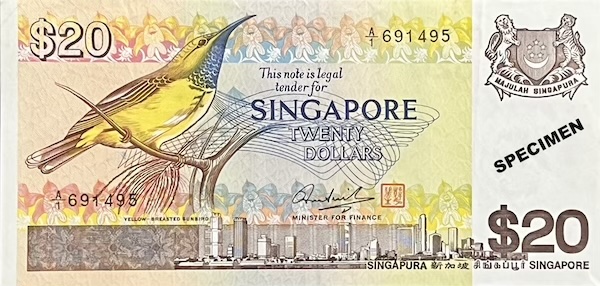
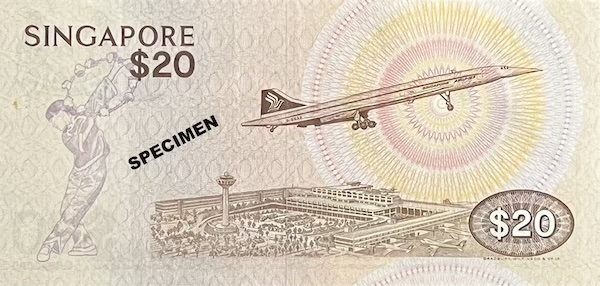
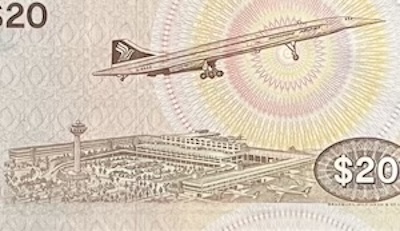
Our excitement grew with the birth of Singapore Airlines and the impending completion of Changi Airport. These would be our gateway to the world, representing the bold steps we were taking to establish our identity on the global stage. The arrival of the Concorde, with its sleek design and supersonic speed, was a moment of pride, showcasing our readiness to embrace the future. While our story with the Concorde turned out to be short-lived, the excitement it generated mirrored the optimism of our young nation in bravely charting our future.
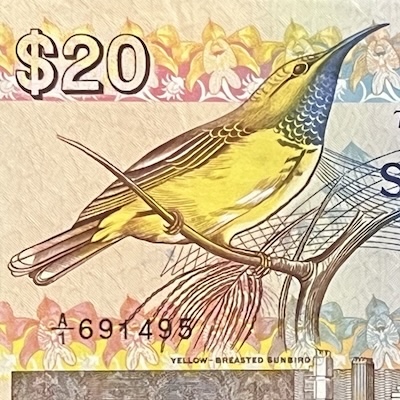
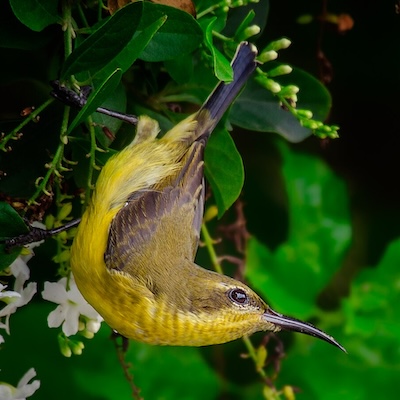
The Bird $20 is special because it is the only $20 note ever made for regular use in Singapore. (Other $20 notes were only issued to commemorate special occasions.) It was created to replace the $25 note, which wasn’t popular as it was not convenient for daily use. However, the $20 note didn’t last long either—it was taken out of circulation after the Bird series because not many people used it. Interestingly, the story of the $20 note is quite similar to the Concorde plane shown on its design. Both were seen as symbols of progress in their time but later disappeared quietly when things didn’t work out as hoped. Another interesting fact: this was the only note in the Bird Series where the name of the bird changed later. At the time, it was called the Yellow-breasted Sunbird, but today we know it as the Olive-backed Sunbird. This leaves the printed name on the banknote a historical snapshot of knowledge that has since evolved.
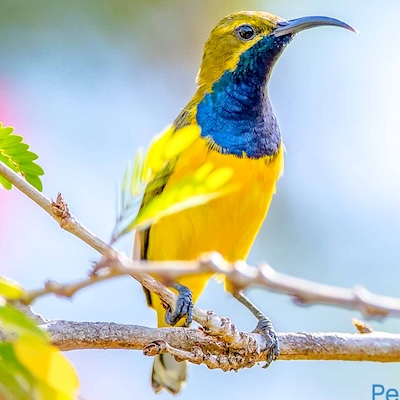
The Olive-backed Sunbird is one of the most common birds in Singapore and can be easily seen in parks, gardens, and even around HDB flats. It’s small, about 11.5 cm long, and very adaptable—some have even been spotted nesting in potted plants on high-rise balconies. Found across Southeast Asia, southern China, and as far as northeast Australia, this bird is known for its high-pitched, metallic chirping. The male has olive-green feathers on top, a shiny blue-black throat, and a yellow belly, while the female is yellow underneath with a curved beak and a bit of white on her tail. It lives in many types of places, from mangroves and forests to urban areas, and is not endangered, making it a familiar sight in most green spaces across Singapore.
When this banknote was issued in 1979, the Olive-backed Sunbird was known in Singapore as the Yellow-breasted Sunbird, a name that highlighted its bright yellow belly. However, around the early 2000s, bird experts began using ‘Olive-backed Sunbird’ to avoid confusion with other sunbirds that also have yellow underparts. The new name points to the olive-green feathers on its back, which are a more unique feature. This change helps birdwatchers and scientists globally refer to the same species clearly and consistently. (P.S. In 2024, the name of this bird has been updated again. It is now known as ‘Garden Sunbird’.)
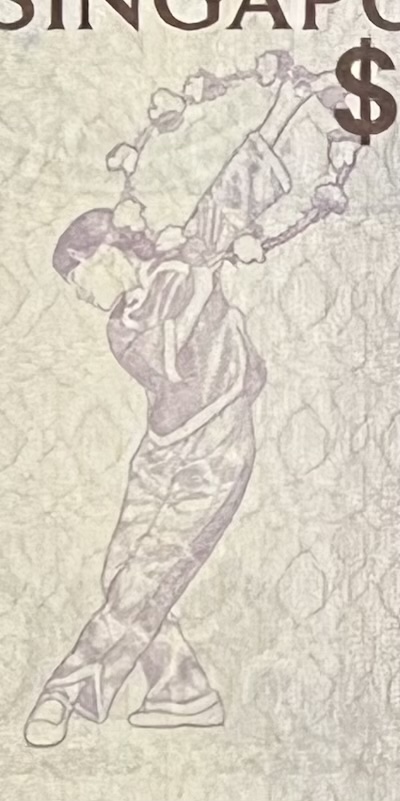
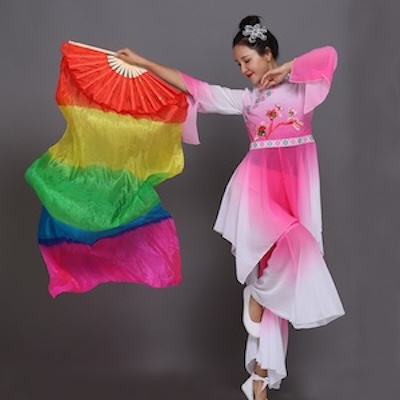
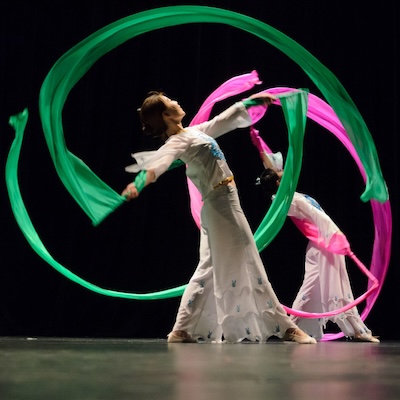
Classical Chinese dance is a graceful and expressive art form that has a long history, going back thousands of years to ancient Chinese opera, royal courts, and traditional theatre. It combines beautiful movements, storytelling, and elements that reflect Chinese culture. Dancers are trained to move their whole body smoothly, use intricate hand gestures, and display emotion through facial expressions. They often use props like fans, long silk sleeves, ribbons, and umbrellas to make the dance more colourful and to symbolise nature or feelings. In Singapore, Classical Chinese dance is still very much alive. It is taught in schools, performed at festivals, and enjoyed at community events.
The Concorde Dream That Never Took Flight
Concorde Over Changi Airport
In 1977, Singapore Airlines (SIA) and British Airways (BA) signed a partnership to jointly fly the Concorde, cutting London-Singapore flying time from 15 hours to 10 hours. The aircraft would feature the SIA livery on one side and the BA livery on the other. The government’s intent behind this partnership was to showcase Singapore as a modern, progressive nation and solidify our position as a global aviation hub. Singapore Airlines, then a young carrier, would also enhance its international prestige by flying the world’s most advanced passenger aircraft.
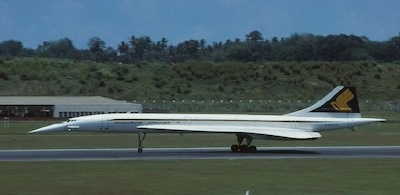
Concorde with SIA Logo at Paya Lebar7
SIA’s venture with British Airways lasted only three years, from 1977 to 1980, due to various challenges. These included political hurdles like Malaysia’s refusal to allow Concorde flights over its airspace, restrictions on supersonic travel due to loud sonic booms, and several notable incidents, such as a bird strike damaging an engine, a passenger being stabbed onboard, and a family home damaged during takeoff.
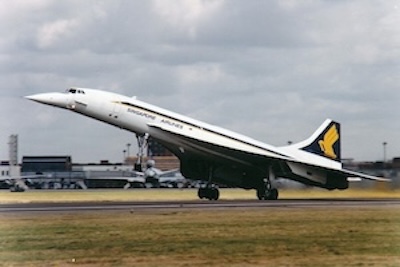
Concorde with SIA Logo at Heathrow8
The scene on the Bird $20 never truly came to life. The Concorde operated by SIA flew only from Paya Lebar Airport, not Changi, which was still under construction when the note was issued in 1979. By the time Changi opened in 1981, SIA’s Concorde partnership with BA had already ended. Even the aircraft’s livery depicted on the note was reversed—the SIA logo, printed on the right side of the plane based on the note, actually appeared on the left in real life. Only two Concorde flights ever landed at Changi, in 1985 and 1986, and neither was operated by SIA.
Market Value in 2024
Market Price: $150
Condition
• Ungraded
• Lightly used
• No tears, pinholes or foxing
• One small stain spot
• Visible creases & folds
Context
• The information here refers specifically to the banknote featured on the top of this page.
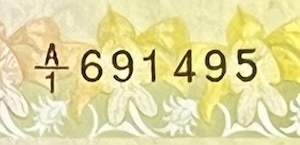
1. Prefix and banknote details from Vincent Tan and Tan Wei Jie, Singapore Banknotes: Complete Prefix Reference, Mr Banknotes, 2017.
2. Information about birds from Yong Ding Li and Lim Kim Chuah, A Naturalist’s Guide to the Birds of Singapore, 2016; and Birds of Singapore, https://singaporebirds.com.
3. Image by Peter Rowland. Source: https://prpw.com.au/project/olive-backed-sunbird/.
4. Image by Domzjuniorwildlife. Source: https://commons.wikimedia.org/wiki/File:Olive-backed_Sunbird_female,_Misamis_Oriental,_Philippines_1.jpg.
5. Image from Wholesale Dance Dress listing. Source: https://www.wholesaledancedress.com/chinese-traditional-folk-yangko-dance-long-silk-fans-for-women-girls-colorful-rainbow-colored-long-floating-dance-fan-performance-props-568437502089.
6. Image from Asian Pacific American Student Assembly. Source: https://www.uscapasa.com/blog/usc-traditional-chinese-dance-11th-annual-showcase-interwoven.
7. Image by Mally T@malcolmtinning, Pinterest. Source: https://www.pinterest.com/pin/222294931595938086/.
8. Image by Daily Quote Singapore, Facebook. Source: https://www.facebook.com/photo/?fbid=961139056120834&set=a.424304493137629.
Disclaimer
I built this website as a hobby, to share with others what I’ve learnt. All the information here is written based on my own research and understanding, and I don’t guarantee that everything is correct, complete, or updated. While I sell banknotes here, I don’t profit from them, as they are spare pieces from my private collection. All the banknote images here are taken by myself and they belong to me. The non-banknote images, with sources that I’ve attributed on every page, are used solely for illustration and non-commercial education purposes. If you are a copyright holder and believe something has been used inappropriately, please contact me, and I will immediately review or remove it.