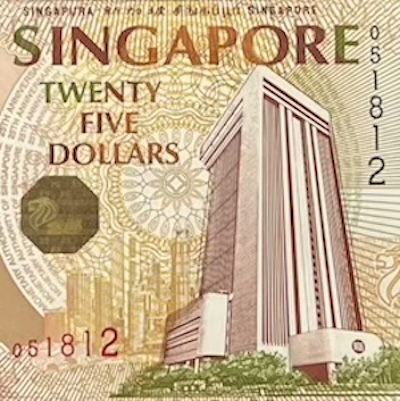
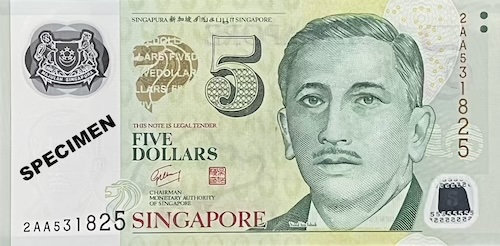
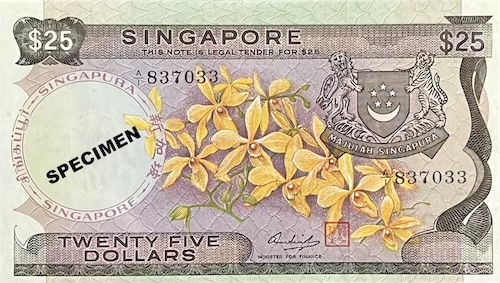
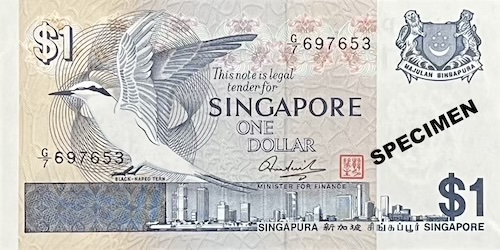
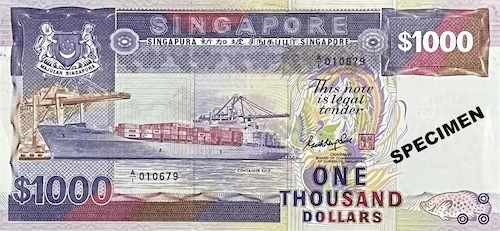
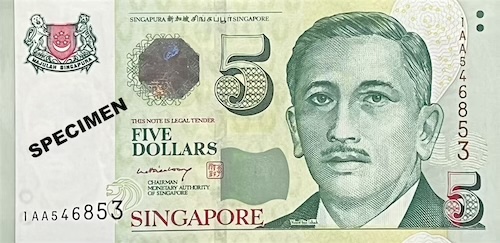
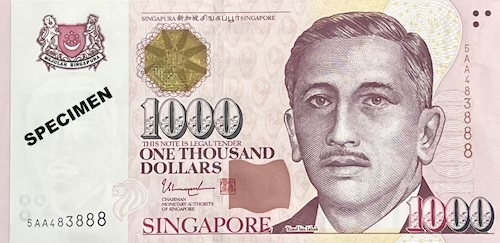
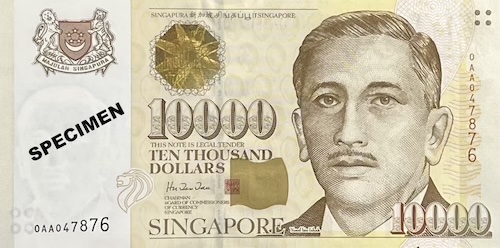
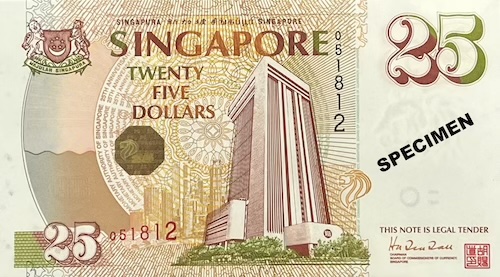
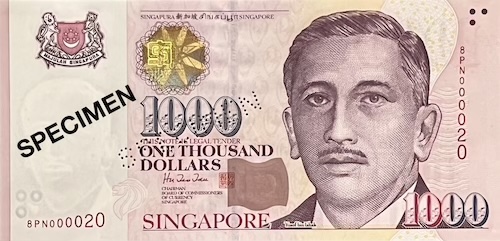
The Singapore government issues two types of banknotes: circulation notes and commemorative notes. Circulation notes are used for everyday spending—these include the Portrait series notes we use today, as well as the Orchid, Bird, and Ship series notes that were used in the past. These notes are printed in large quantities and reprinted when needed. Commemorative notes, on the other hand, are special notes made to mark important events, such as the 25th anniversary of MAS, the 40th anniversary of the currency agreement with Brunei, or Singapore’s 50th year of independence. These are printed in limited numbers and only released once. Most people don’t see them in daily life because they are usually kept as collectibles.
O25: Circulation-Discontinued
B1: Circulation-Discontinued
S1000: Circulation-Discontinued
P5 (Paper): Circulation-Discontinued
P1000: Circulation-Discontinued
P10000: Circulation-Discontinued
Some circulation notes have been discontinued, which means they are no longer reprinted or reissued. When a new series is introduced, the old one is phased out. With the Portrait series in use now, the Orchid, Bird, and Ship series notes have all been discontinued. Even within the Portrait series, some notes have been stopped too. The paper versions of the $2, $5, and $10 notes have been replaced by plastic (polymer) ones, and the $1000 and $10000 notes were discontinued in 2021 and 2014 respectively to reduce the potential for money laundering. For the banks, there is a slight difference in how they manage the $1000 and $10000 discontinued notes: any $10000 note received will be returned to MAS, but $1000 notes can still be released back into circulation—just that no new ones will be issued. This means that today, the only notes still in active circulation are the Portrait $2 (polymer), $5 (polymer), $10 (polymer), $50, and $100, with the $1000 still being used but not reprinted.
MAS25: Commemorative-Special Design for MAS 25th Anniversary
P1000: Commemorative-Special Edition for Launch of Yusof Ishak Books
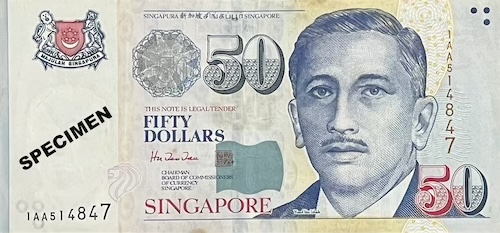
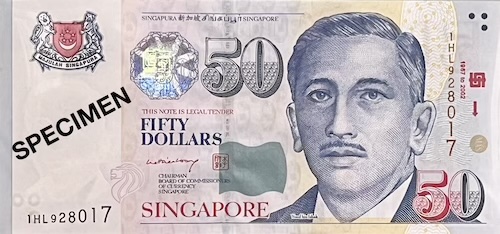
P50: Commemorative-Special Edition for Handover of BCCS to MAS
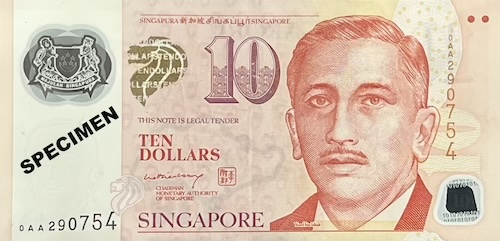
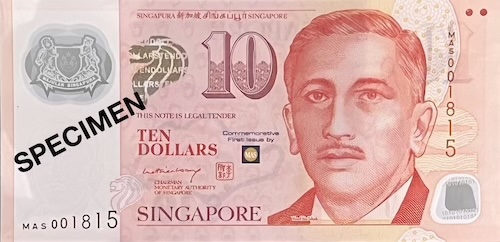
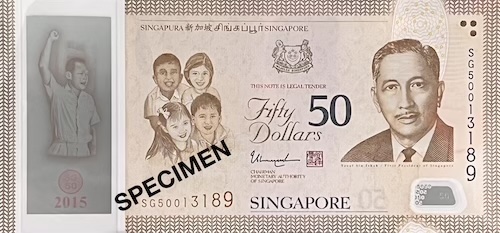
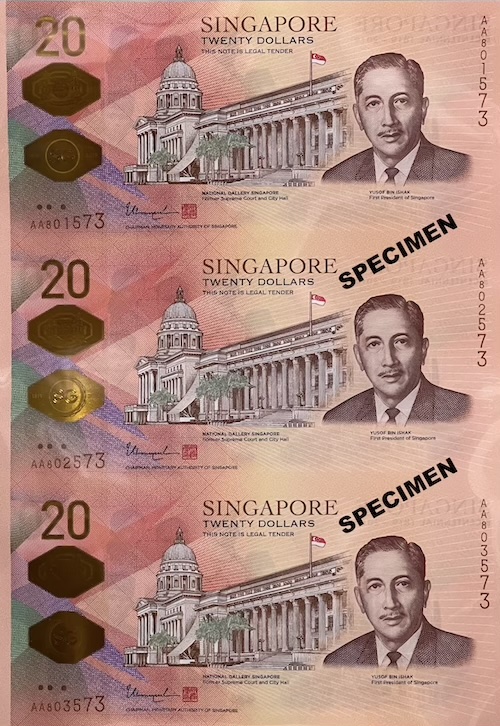
Commemorative notes come in three types. Some have completely new designs created for major national events. Examples include the 1990 SG25, 1996 MAS25, 2007 CIA40, 2015 SG50, 2017 CIA50, and 2019 B200 notes. Others closely resemble regular notes but include small changes, such as a special overprint, a unique prefix, fancy serial numbers, or being issued as uncut sheets. These are made for smaller, but still meaningful occasions—for example, the launch of a pair of books about President Yusof Ishak and the Portrait series, which included a $1000 specimen note; the transfer of note-issuing duties from BCCS to MAS, marked by an overprint of both organisations’ logos on a Portrait $50; or the first issue of currency notes by MAS, which featured a “MAS” prefix and the MAS logo on a Portrait $10. On rare occasions, a commemorative note can even be both—a special edition of a special-design note. Examples include the SG50 note, which had an “SG50” prefix and blue serial numbers used on the 2015 SG50 $50, and the B200 note, which featured a 3-piece uncut version of the 2019 B200 note.
P10: Commemorative-Special Edition for MAS First Issue
SG50: Commemorative-Special Edition of Special Design for SG50
B200: Commemorative-Special Edition of Special Design for Singapore B200
All circulation and commemorative notes—including discontinued notes—are legal tender, meaning they can be used to pay for goods and services. For example, you can still use an Orchid, Bird, or Ship $100 note to buy something worth $100, and shops must accept it. You can also bring these notes to the bank and deposit them at their face value. However, most ATMs in Singapore only accept Portrait series notes. ATMs are not calibrated to accept old notes from the Orchid, Bird, or Ship series, and they also cannot process commemorative notes, which are not part of the regular currency system and intended for collectors.
Disclaimer. I built this website as a hobby, to share with others what I’ve learnt. All the information here is written based on my own research and understanding, and I don’t guarantee that everything is correct, complete, or updated. While I sell banknotes here, I don’t profit from them, as they are spare pieces from my private collection. All the banknote images here are taken by myself and they belong to me. The non-banknote images, with sources that I’ve attributed on every page, are used solely for illustration and non-commercial education purposes. If you are a copyright holder and believe something has been used inappropriately, please contact me, and I will immediately review or remove it.