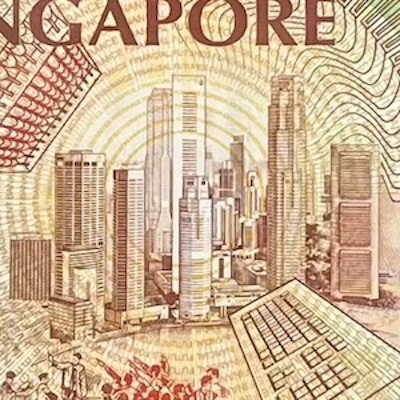
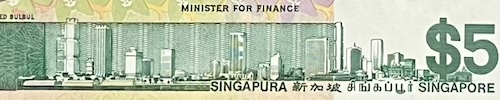
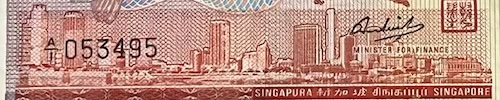
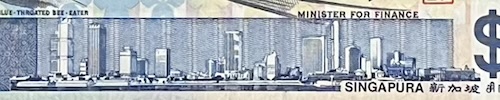
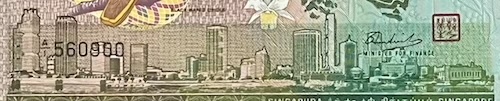
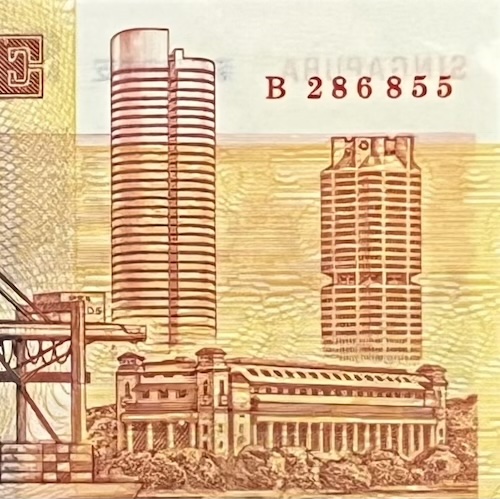
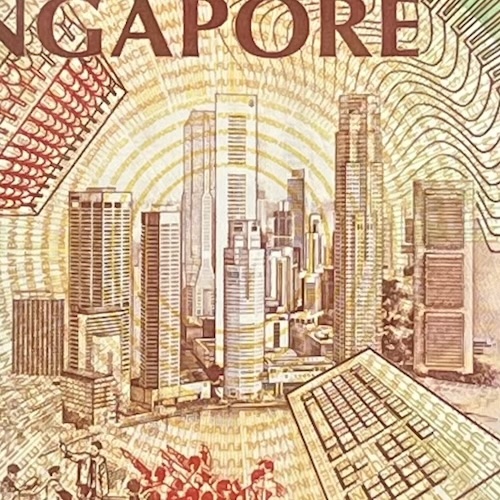
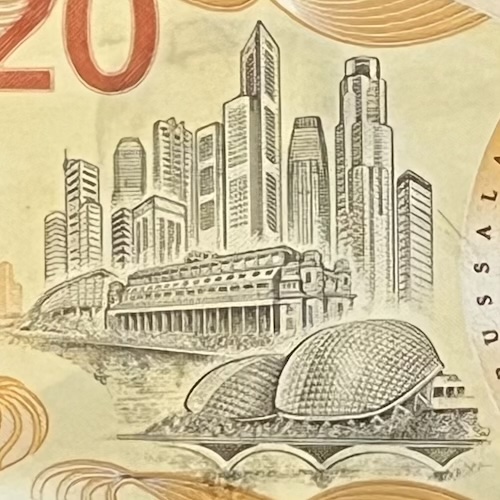
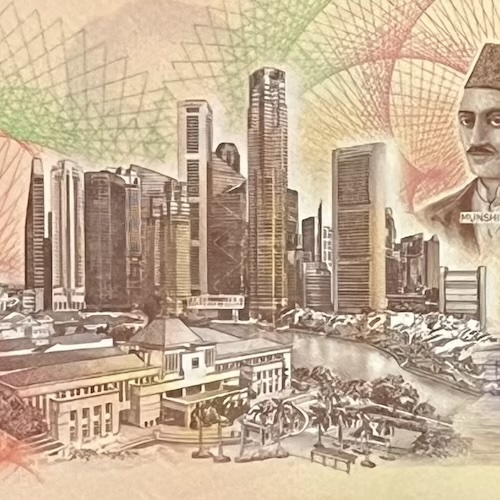
The financial district has been the lifeblood of Singapore. It is the part of our heritage that shows how we have survived and grown through economic success. When we became independent, we had no natural resources—no oil, no land, no minerals—so we had to rely on trade, finance, and enterprise to build our future. The district is therefore featured on many of our banknotes: all the notes in the Bird series, the background of the Ship $50, Ship $10000, and Portrait $5 notes, as well as on commemorative notes like the 1990 SG25, 1996 MAS25, 2007 CIA40, and 2019 Bicentennial.
B5
B10
In 1965, our financial district—soon to be named the “Golden Shoe”—looked nothing like it does today. The area was crowded with run-down shophouses and home to over 180,000 people living in poor conditions. The streets were jammed with traffic, sanitation was lacking, and disease outbreaks were common. Still, the land was in a key location, with vast potential. In 1967, the government formed the Urban Renewal Department and began selling land to encourage redevelopment. Landowners received support to rebuild, and residents were relocated. Early high-rise buildings like the Overseas Union House, the Change Alley Aerial Plaza, and the three towers at Shenton Way signalled the start of change.
S50
B100
During the 1970s and 1980s, the area quickly transformed. Big banks like OCBC, UOB, and DBS built their own towers—OCBC Centre became the tallest building in Southeast Asia in 1976. Government agencies such as the CPF Board and the MAS also moved into the area. This mix of banks and public institutions turned the district into a centre for finance. Continuing the redevelopment throughout the 1990s and 2000s, older buildings were torn down, and the city expanded into newly reclaimed land at Marina Bay. New sites like One Raffles Quay and Marina Bay Financial Centre were built, while historic places such as Clifford Pier and Change Alley were conserved and adapted for new uses.
B500
S10000
In the 2010s and 2020s, the focus shifted again. The district began moving towards mixed-use spaces, where offices, homes, and shops could exist in the same buildings. New developments like Ocean Financial Centre and Capital Tower reflected this trend. At the same time, older towers like DBS and CPF were sold off and redeveloped. Today, the financial district—from Raffles Place to Marina Bay—is a dynamic space for finance, business, lifestyle, and tourism. It shows how far Singapore has come since our independence, shaped by careful planning, partnerships between government and private developers, and a steady willingness to adapt.
Disclaimer. I built this website as a hobby, to share with others what I’ve learnt. All the information here is written based on my own research and understanding, and I don’t guarantee that everything is correct, complete, or updated. While I sell banknotes here, I don’t profit from them, as they are spare pieces from my private collection. All the banknote images here are taken by myself and they belong to me. The non-banknote images, with sources that I’ve attributed on every page, are used solely for illustration and non-commercial education purposes. If you are a copyright holder and believe something has been used inappropriately, please contact me, and I will immediately review or remove it.