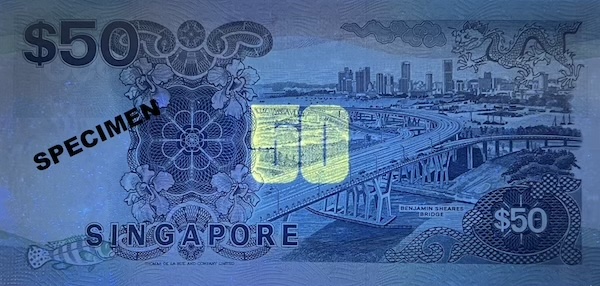
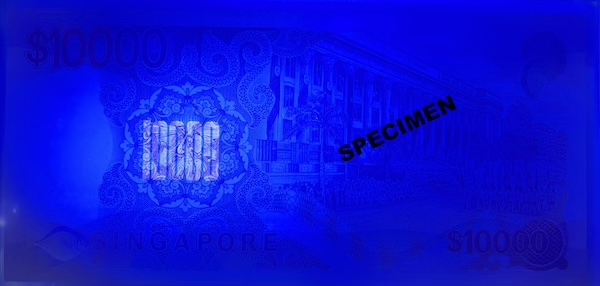
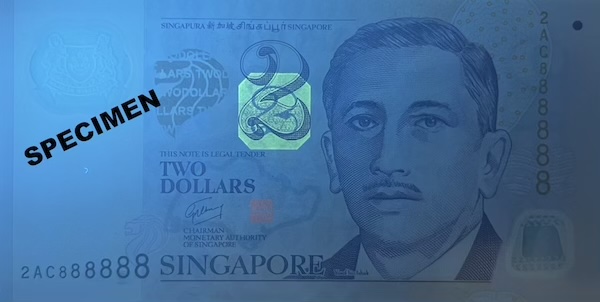
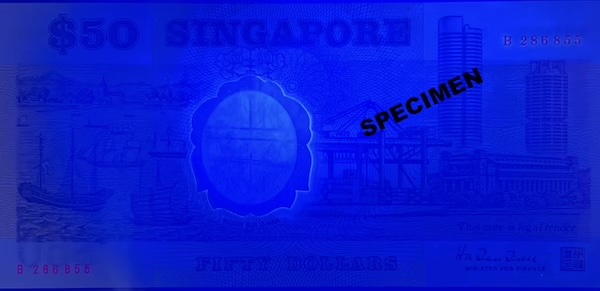
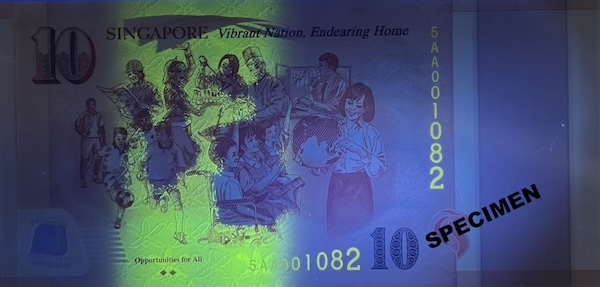
Fluorescent ink makes banknotes harder to counterfeit by reacting to ultraviolet (UV) light. Some elements are printed using ink mixed with fluorescent pigments—these look normal under regular light but glow under UV. Others use ink that leaves no visible trace under normal light, appearing only under UV. These features allow quick authentication by cashiers, bank staff, and collectors, without the need for specialised machines. Today, fluorescent features are standard in banknote design worldwide, including in Singapore.
O5: Glowing Features
O100: Glowing Features
O10000: Glowing Features
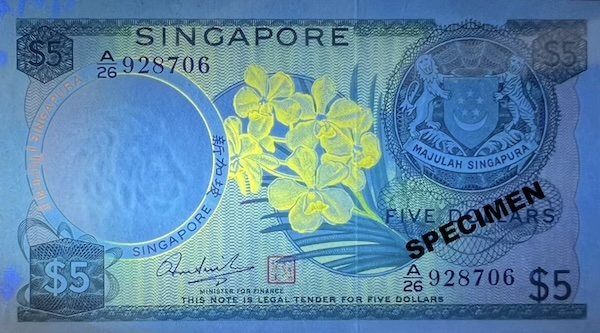
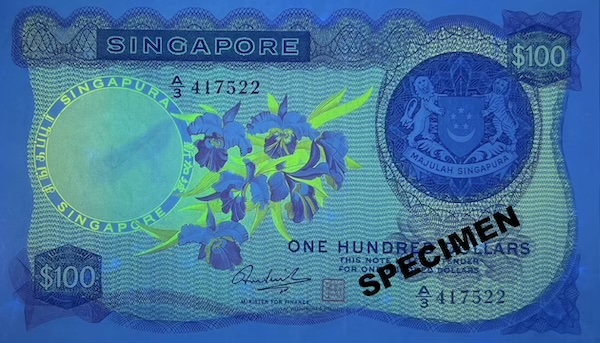
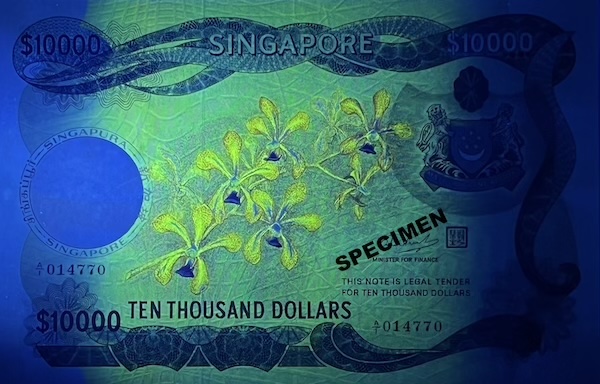
In the Orchid series, fluorescent ink was used only in the notes printed by BWC ($1, $5, and $100) and the later TDLR-printed denominations ($25, $500, and $10,000). The ink was applied to the orchid motif and the ring of the word “SINGAPORE” in four languages. I cannot be entirely sure, but the earlier TDLR-printed notes ($10, $50, $1,000) did not appear to have used fluorescent ink.
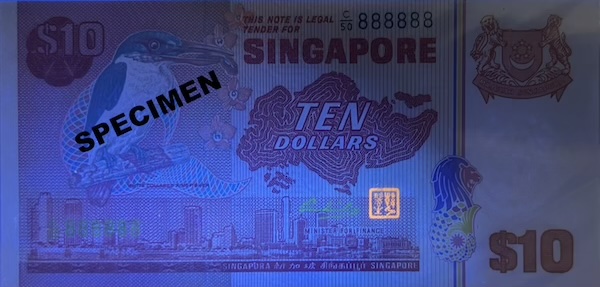
B10: Glowing Features
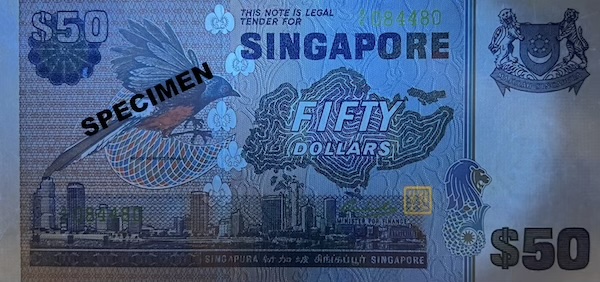
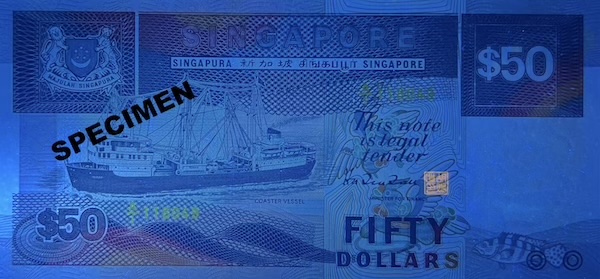
B50: Glowing Features
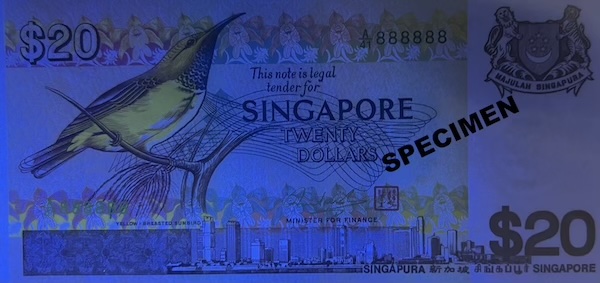
B20: Glowing Features
In the Bird series, fluorescent ink was applied on all denominations—on serial numbers, signatures, and the Chinese seal. On the $20 note, it was also used on the Olive-Backed Sunbird and background floral patterns, but not on the bird or background of the other denominations.
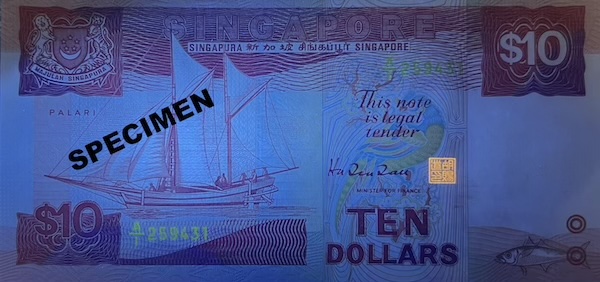
S10: Glowing Features
S50: Glowing Features
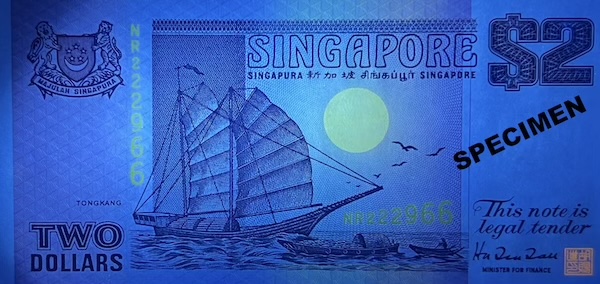
S2: Glowing Features
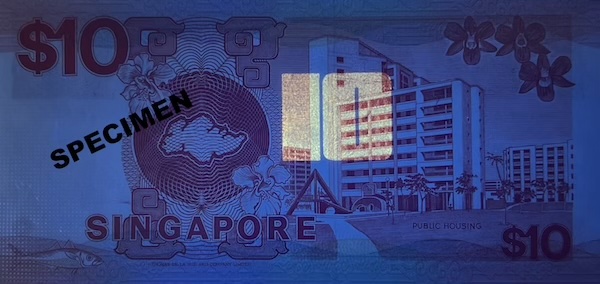
In the Ship series, fluorescent ink was again used on serial numbers and the Chinese seal, but no longer on the signature. It was also used on the sun motif of the $2 note.
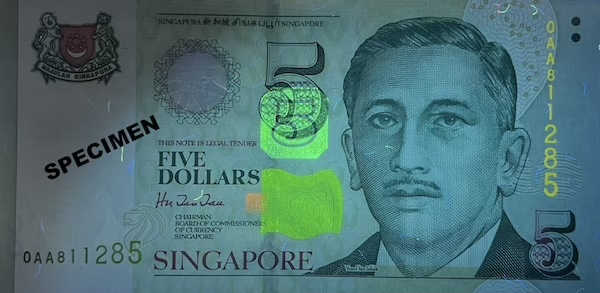
P5 Paper: Glowing Features & Hidden Number
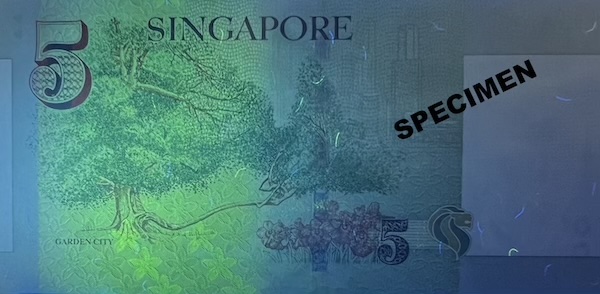
P5 Paper: Glowing Features & Fluorescent Fibres
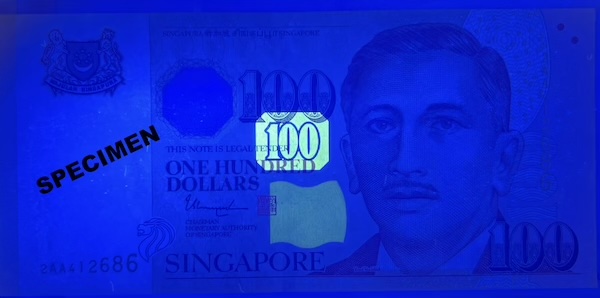
P100: Hidden Number & Glowing Features
In the Portrait series, fluorescent ink was used on the serial numbers, Chinese seal, the latent image patch (which features on paper notes only), and the background images. These paper notes also contain fluorescent fibres—tiny, hair-like strands embedded into the paper during manufacture and not added by printing.
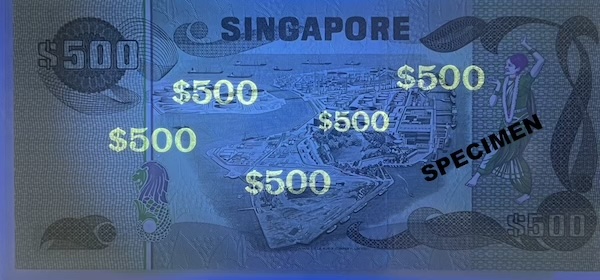
B500: Hidden Numbers
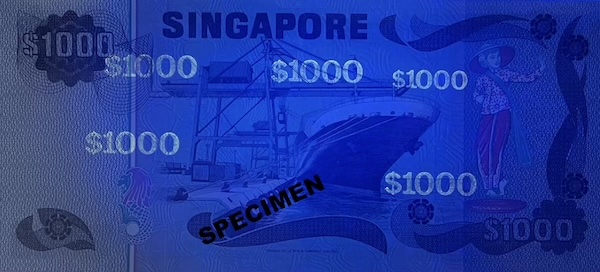
B1000: Hidden Numbers
S10: Hidden Number
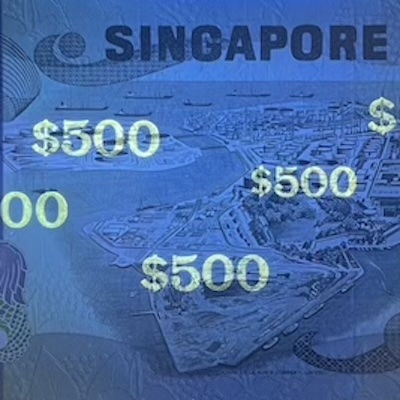
As for UV-only features, which are invisible under normal light, these began with the Bird series. On the back of the high-denomination notes ($100 and above), a set of numerals like “100” or “1000” appear only under UV. The Ship series continued this, incorporating one or two hidden numbers on the $5 to the $10,000 notes. In the Portrait series, all denominations (paper and polymer) show a single UV-only number on the front. The two highest denominations are stylised as “1K” or “10K” instead of “1000” or “10000”.
S50: Hidden Number
S10000: Hidden Number
P2 Polymer: Hidden Number
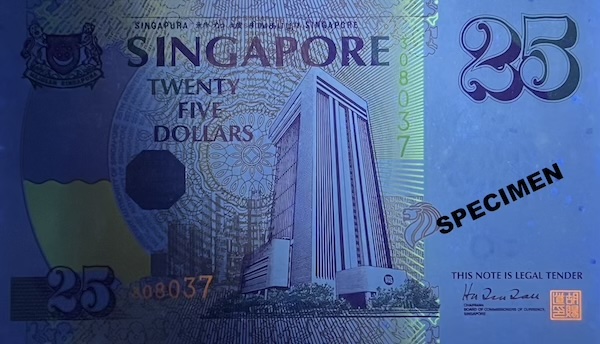
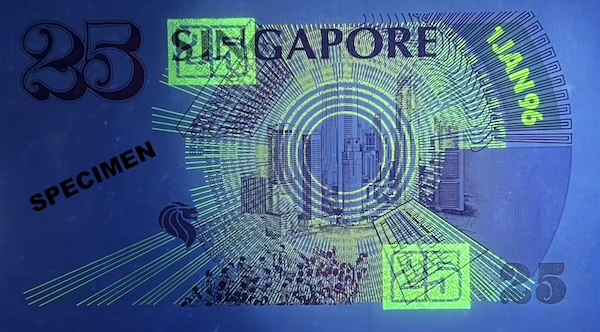
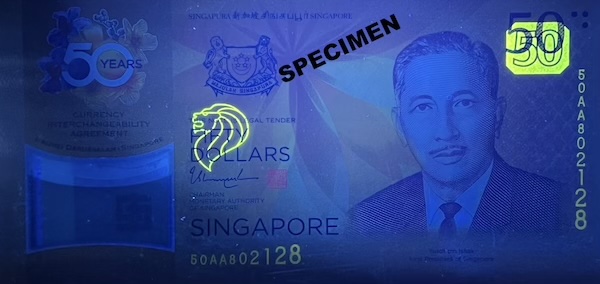
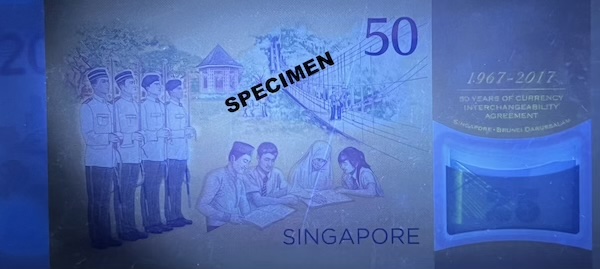
Commemorative notes also use fluorescent ink. The 1996 MAS 25th Anniversary $25 note had the most extensive use: fluorescent ink was applied on the serial numbers, Chinese seal, front and back motifs, and hidden elements like a “$25” and “1 Jan 96” visible only under UV. In contrast, the 1990 SG 25th Anniversary $50 note used fluorescent ink only on the serial numbers.
SG25: Glowing Features
MAS25: Glowing Features
MAS25: Glowing Features & Hidden Numbers
For older notes—especially from the Orchid, Bird, and Ship series—the fluorescent features be less prominent, or sometimes barely visible. Fluorescent ink fades with time and handling. However, a missing glow does not mean the note is fake—to be sure, we have to check the other security features first. However, this test can reveal if a note is truly new. If a seller claims a note is brand new but none of its features glow under UV, it may have been cleaned to trick you into thinking it is uncirculated.
Disclaimer. I built this website as a hobby, to share with others what I’ve learnt. All the information here is written based on my own research and understanding, and I don’t guarantee that everything is correct, complete, or updated. While I sell banknotes here, I don’t profit from them, as they are spare pieces from my private collection. All the banknote images here are taken by myself and they belong to me. The non-banknote images, with sources that I’ve attributed on every page, are used solely for illustration and non-commercial education purposes. If you are a copyright holder and believe something has been used inappropriately, please contact me, and I will immediately review or remove it.