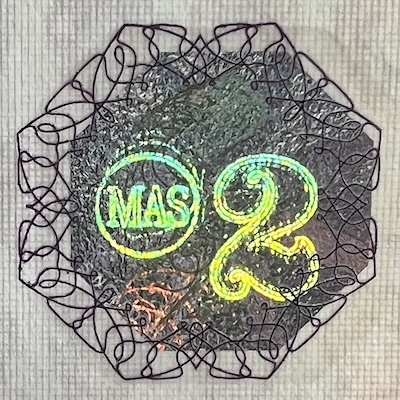
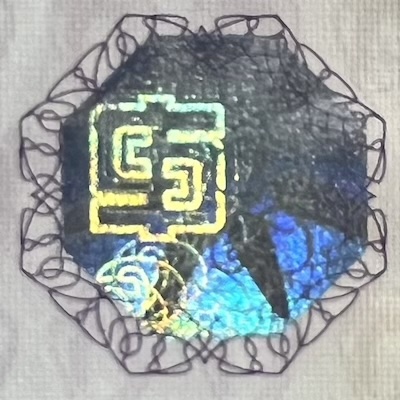
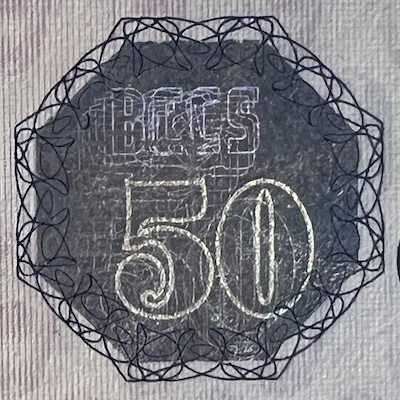
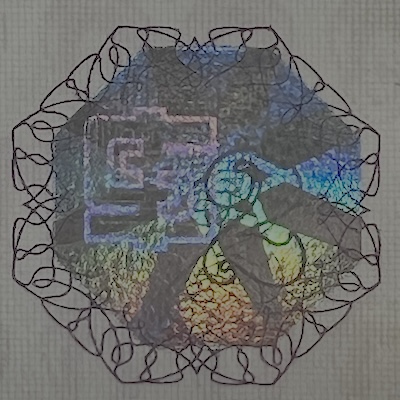
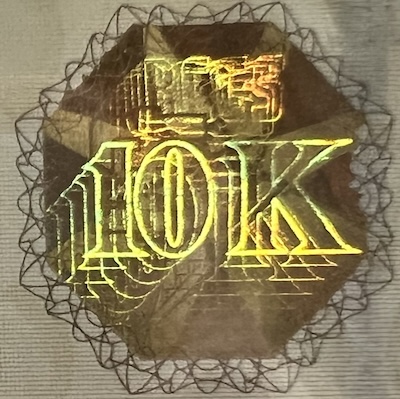
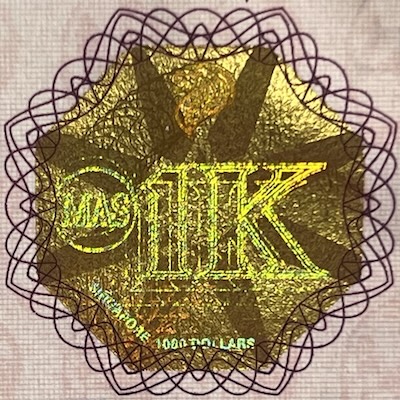
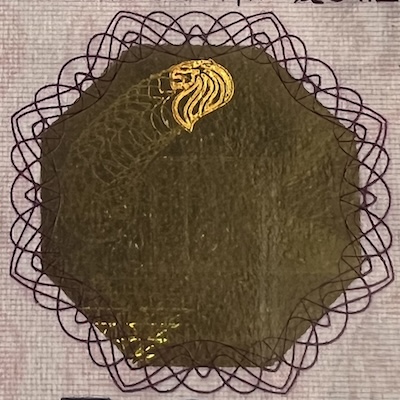
Kinegram is the brand name for a type of metallic security patch that shows different images when the note is tilted. It is made using a specialised micro-engraving process that creates motion or switching effects depending on the viewing angle. The name comes from “kine-” (movement) and “-gram” (image). It is a registered trademark of the Swiss company OVD Kinegram AG. The images are built into the foil using microscopic engraving, making the Kinegram difficult to reproduce with regular printing methods. The technical details of the process are not publicly disclosed.
P2: BCCS Logo & Shimmer
P50: "BCCS" & Value
P2: BCCS Logo & Value
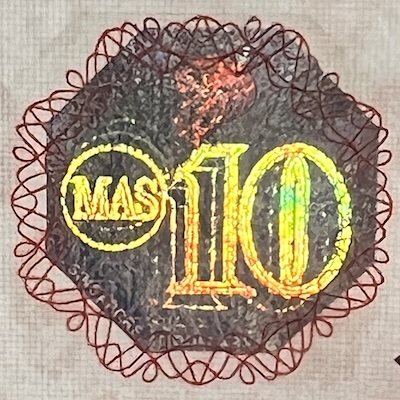
P10: MAS Logo & Value
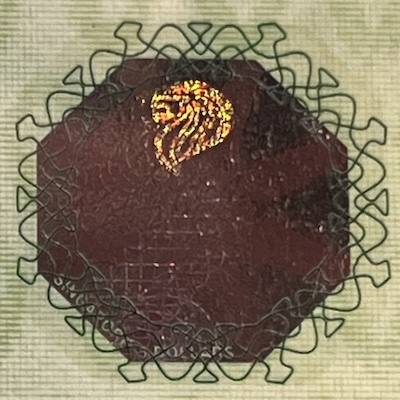
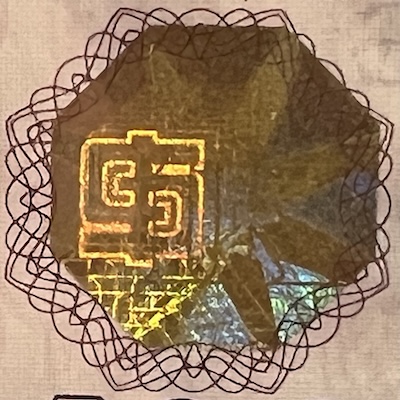
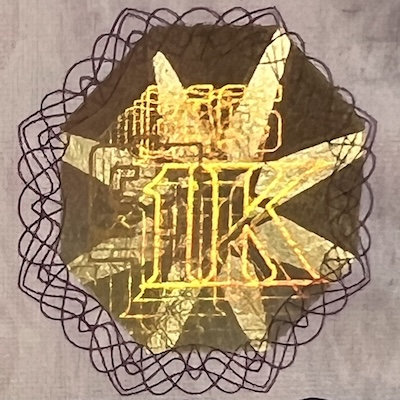
In Singapore’s Portrait series, Kinegrams were used as a security feature. On the $2 to $100 denominations, the Kinegram appears as an octagonal silver foil on the front of the note. On earlier notes issued by the Board of Commissioners of Currency Singapore (BCCS), the Kinegram foil showed the BCCS logo, the letters “BCCS,” or the denomination number, depending on how the note was tilted. It also had a background of electron orbital shapes that shifted from light to dark and shimmered in different colours when rotated. After the Monetary Authority of Singapore (MAS) took over, the Kinegram was updated to show the Lion Head symbol, the MAS logo, or the denomination number. The background shimmer remained the same. On the $1,000 and $10,000 notes, the Kinegram foil was changed from silver to gold, and the denomination numbers were shown as “1K” and “10K.” These gold Kinegrams displayed either the BCCS markings, the MAS logo, or Lion Head symbol, depending on the version.
P5: Lion Head
P1000: BCCS Logo
P1000: "BCCS" & Value
P10000: "BCCS" & Value
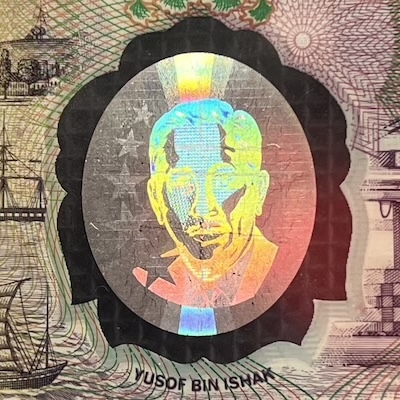
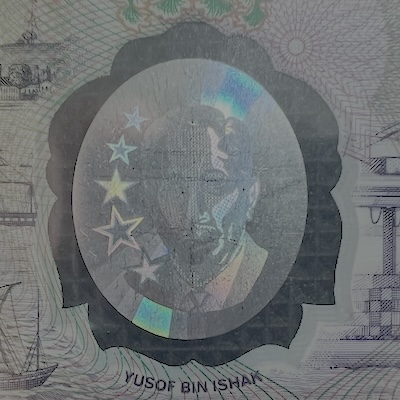
None of the commemorative notes used a true Kinegram. Only the 1990 SG25 $50 commemorative note used a hologram—a Kinegram-like feature—instead. It showed a metallic image of President Yusof Ishak that reflected a rainbow of colours when the note was tilted. It also reveals five stars, which represent our national ideals of democracy, peace, progress, justice, and equality. This hologram was an early version of optical security features but did not use the same technology as a Kinegram.
Disclaimer. I built this website as a hobby, to share with others what I’ve learnt. All the information here is written based on my own research and understanding, and I don’t guarantee that everything is correct, complete, or updated. While I sell banknotes here, I don’t profit from them, as they are spare pieces from my private collection. All the banknote images here are taken by myself and they belong to me. The non-banknote images, with sources that I’ve attributed on every page, are used solely for illustration and non-commercial education purposes. If you are a copyright holder and believe something has been used inappropriately, please contact me, and I will immediately review or remove it.