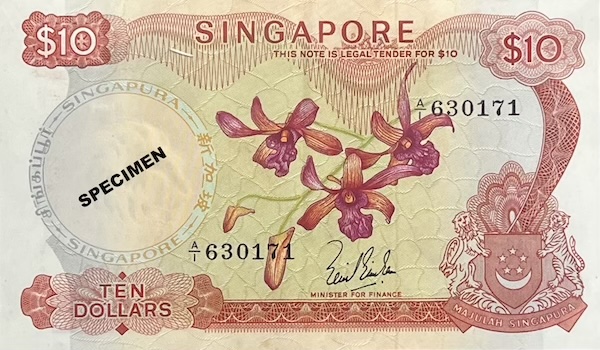
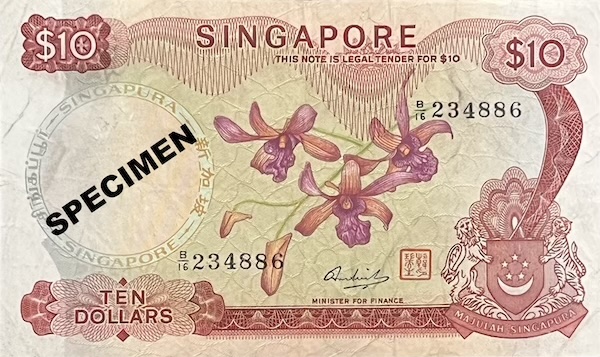
Orchid $10 (1967)

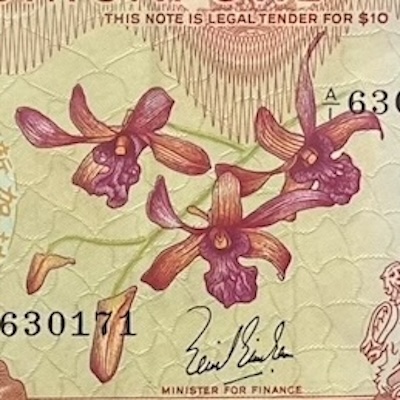
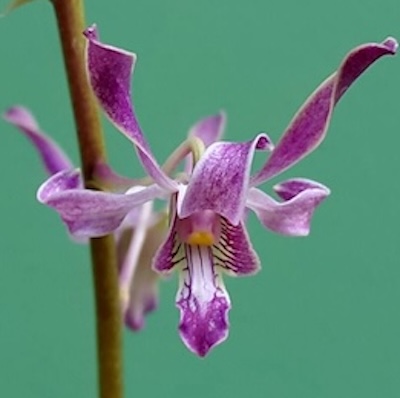
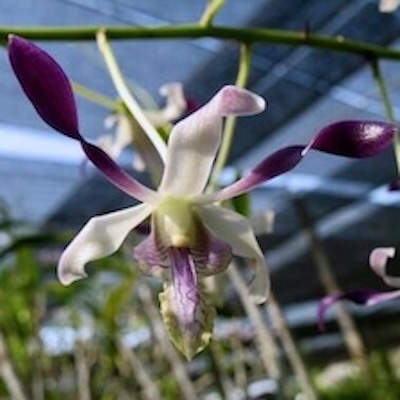
Orchid: Dendrobium Marjorie Ho 'Tony Pek'
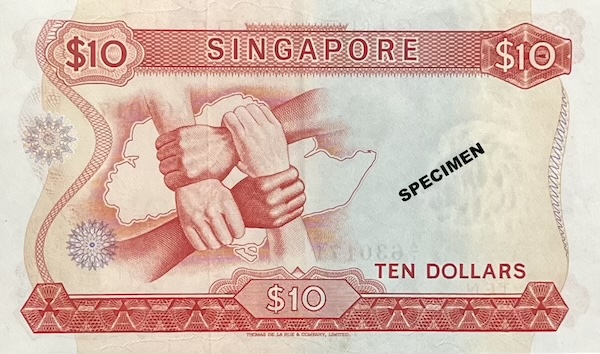
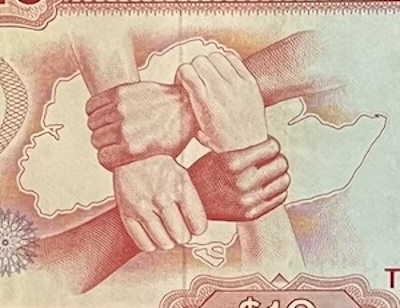
Image: Clasped Hands over Outline Map of Singapore

Many Races, One Nation

From Day One, our government understood the importance of our four races—Chinese, Malay, Indian and Eurasians—living in solidarity. Following increased tension that led to a series of racial riots and civil disorder, the four clasped hands on the banknote symbolised the importance of racial harmony as we navigated the complexities of building a nation from diverse communities. Placed over an outline map of Singapore island, the hands were a reminder that our differences must not be a barrier, but a source of strength. They were a symbol of our shared journey and our commitment to mutual respect towards one another.

Circulation status: Discontinued

Issuing authority: BCCS

First issued: 12 June 1967

Pieces issued: 195 million

Printer: Thomas De La Rue & Co Ltd

Material: Paper

‘Singapore’ in caps

‘Singapore’ in four languages

National Coat of Arms

Outline map of Singapore

Orchid: Dendrobium Marjorie Ho ‘Tony Pek’ (front)  
Image: Clasped hands over outline map of Singapore (back)

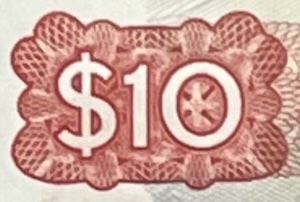
Denomination print: ‘$10’ & ‘TEN DOLLARS’ 

Size: 133mm x 79mm

Colour: Red

Guarantee: Legal tender affirmation

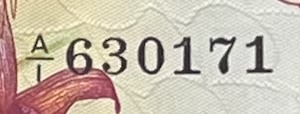
First prefix: A1

Last prefix: B95

Replacement prefix: Z1

Signed by: Minister for Finance

• A1 to A65: Lim Kim San (no seal)

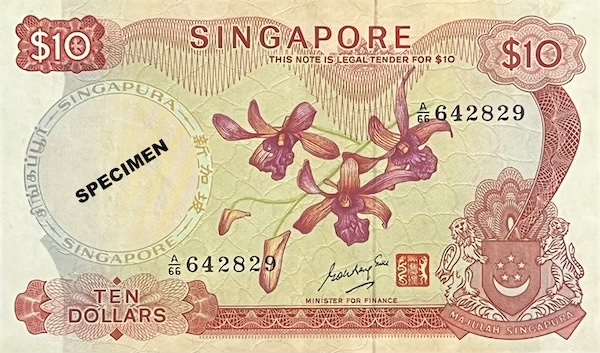
• A66 to A80: Goh Keng Swee (with seal)  

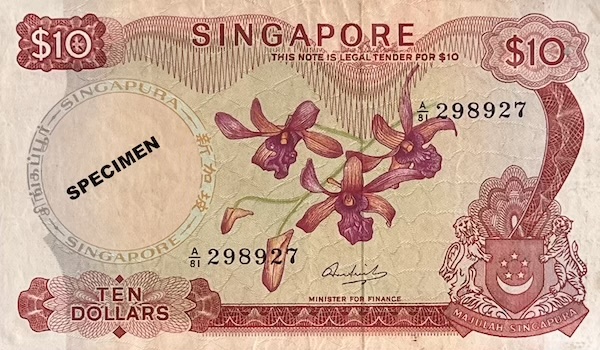
• A81 to B15: Hon Sui Sen (no seal) 

• B16 to B95: Hon Sui Sen (with seal)

• Z1: Hon Sui Sen (no seal/with seal)

Watermark of lion’s head

Fluorescent ink

One solid, vertical security thread

Intaglio print

Geometric patterns

Signed by: Lim Kim San (No Seal)
Signed by: Goh Keng Swee (With Seal)
Signed by: Hon Sui Sen (No Seal)
Signed by: Hon Sui Sen (With Seal)

The First to Map a Nation, a Note in Every Hand

The Orchid $10 note was special in three ways. First, it was the most widely used denomination, even though it had fewer pieces issued than the $1. This was because there was also a $1 coin in use at that time, which reduced reliance on the $1 note. Second, it was the first time an outline map of Singapore was featured on our currency notes. Although this was the only time the map appeared in the Orchid notes, it would appear in many of our banknotes from the Bird series onwards. Third, it was the only one among all of Singapore’s banknotes to spot a 3-digit prefix numeral: the A100. All other prefix numerals were one, or at most two, digits (e.g A7 or B99). 

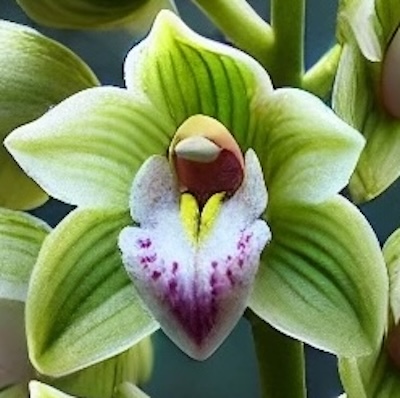
Dendrobium Marjorie Ho 'Tony Pek'
Dendrobium Gouldii (Seed Parent)3
Dendrobium Gouldii (Seed Parent)4
Dendrobium Guadalcanal (Pollen Parent)5

Genus: Dendrobium 

Grex: Marjorie Ho 

Cultivar: Tony Pek

Registrant: A.C. Ho   

Originator: Hung Ung Young (1956)

Dendrobium is one of the largest orchid groups, with over 1,800 types that come in many different shapes and sizes. Because these orchids are resilient and long-lasting, they were ideal for export and played a big role in helping Singapore build its flower trade in the 1960s. As Singapore’s orchid industry grew, many hybrid Dendrobiums were created and given special names. Some of these names included a cultivar, such as Tony Pek, Teo Choo Hong, or Chay. A cultivar is like a nickname that helps to tell apart a special version of the orchid, usually because it has a unique colour or shape compared to others in the same group. In this case, Tony Pek is a specific version of the Dendrobium Marjorie Ho.  

Fragile Bonds in A Young Nation Divided by Race

Four Clasped Hands

In the 1960s, Singapore was a young and fragile country facing serious racial tensions. These problems had built up over time because of our colonial past, unequal wealth distribution, and political rivalry. People of different races mostly lived in their own areas and did not mix much outside of work or business. This made it easier for misunderstandings and mistrust to grow. There was also competition for jobs and business opportunities, which sometimes caused resentment between groups trying to find their place in a fast-changing Singapore. Even politics made things worse—many political parties and groups were based on race, which added to the tension between communities.

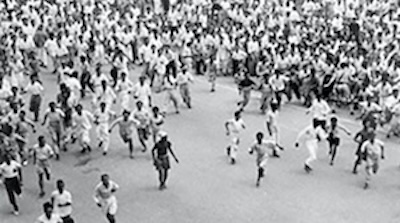
1964 Racial Riots6

In July 1964, a racial riot broke out after someone threw a glass bottle into a crowd of about 20,000 Malays who were taking part in a procession to celebrate Prophet Muhammad’s birthday. This led to angry exchanges between the marching Malays and the Chinese bystanders, which escalated into punches and more bottles being hurled. As word of the riot spread, others joined in, resulting in fights breaking out across the island. The riots lasted 17 days, 23 people lost their lives, and 454 were injured.

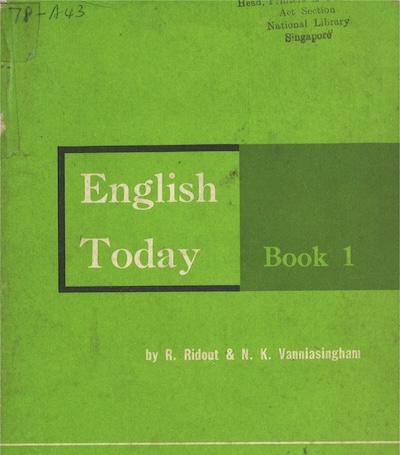
English Textbook in the 1960s7

The 1960s saw heated debates over language policies. Malay was declared the national language to acknowledge the indigenous Malay community and maintain harmony with Malaysia, but English would be the working language to unite Singaporeans of different races. Some in the Chinese and Tamil communities viewed this as sidelining their ethnic languages, while some in the Malay community felt their language had been honoured in name but not in practice. This added to the tensions already swirling around race and cultural identity.  

Market Value in 2024

Market Price: $480

Condition

• Ungraded

• Lightly used

• No tears, pinholes, stains or foxing

• Visible creases & folds 

Context  

• The information here refers specifically to the banknote featured on the top of this page.

• The same note may fetch a higher price if it is graded, in superior condition, has special serial numbers, or is a specimen or error note.

• The same note may fetch a lower price if it lacks the first prefix A1 or is in poorer condition.

Attributions

1. Prefix and banknote details from Vincent Tan and Tan Wei Jie, Singapore Banknotes: Complete Prefix Reference, Mr Banknotes, 2017

2. Orchid registration details from International Orchid Register

3. Image by musyanstubbing-0, eBay listing. Source: https://www.ebay.com.au/itm/126121401322.

4. Image by Neo Tuan Hong. Source: https://orchidroots.com/display/summary/orchidaceae/100059501.

5. Image generated by ChatGPT using DALL·E (OpenAI), 2025

6. Image from Nexus, Ministry of Defence. Source: https://www.sg101.gov.sg/social-national-identity/examples/racialriots.

7. Image from National Library Board. Source: https://biblioasia.nlb.gov.sg/vol-13/issue-4/jan-mar-2018/textbooks-we-remember.

Disclaimer
I built this website as a hobby, to share with others what I’ve learnt. All the information here is written based on my own research and understanding, and I don’t guarantee that everything is correct, complete, or updated. While I sell banknotes here, I don’t profit from them, as they are spare pieces from my private collection. All the banknote images here are taken by myself and they belong to me. The non-banknote images, with sources that I’ve attributed on every page, are used solely for illustration and non-commercial education purposes. If you are a copyright holder and believe something has been used inappropriately, please contact me, and I will immediately review or remove it.

Shudoo: [email protected] 
Shopping Basket