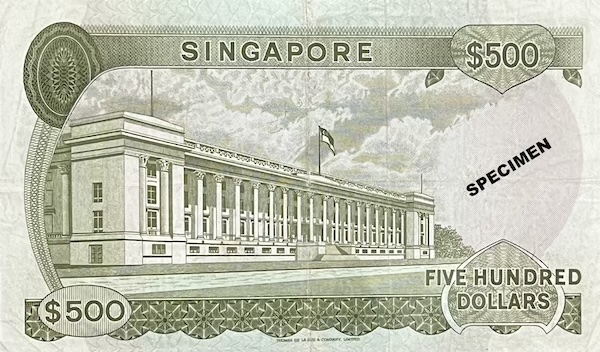
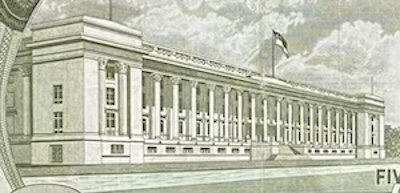
The government offices at St Andrew’s Road were the heart of our administration. Here, policies were crafted, dilemmas were resolved, and difficult decisions were made. Every day brought forth a tapestry of hope and determination, as civil servants navigated the challenges facing a fledgling nation in a time of rapid change. It was here that ideas ranging from urban planning to social policies were brainstormed to shape the growth of Singapore for years to come.
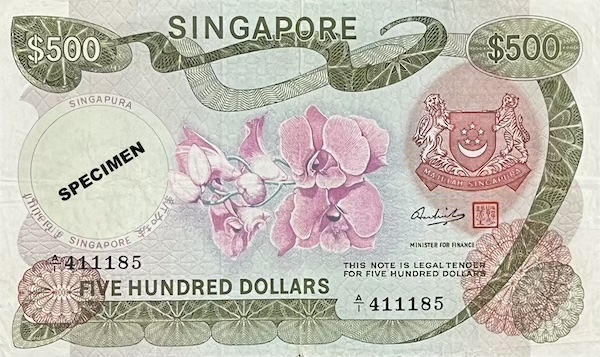
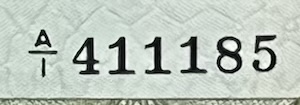
The Orchid $500 note shared several similarities with the Orchid $25. Both marked the first time Singapore introduced these denominations, which had not been part of the colonial currency system which featured $1, $5, $10, $50, $100, $1000, and $10000 notes. The $25 and $500 were issued together in 1972, five years after the initial release of the more familiar denominations. This staggered rollout was intentional—the government believed that introducing the familiar denominations first would ease the public’s transition to our own currency. In addition, unlike the earlier notes, which featured four different signature varieties and an inconsistent use of the red Chinese seal, the $25 and $500 notes had no variants: all of them carried the signature of Hon Sui Sen and included his seal.
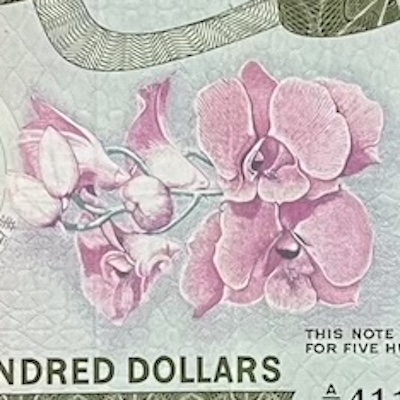
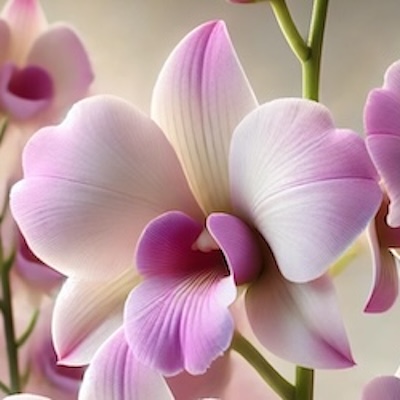
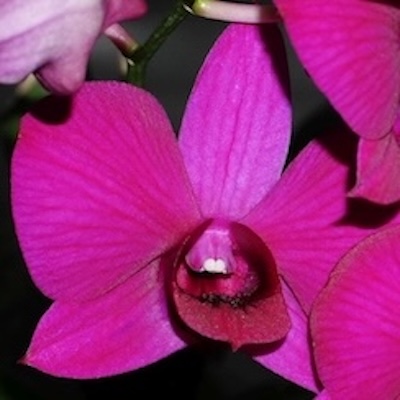
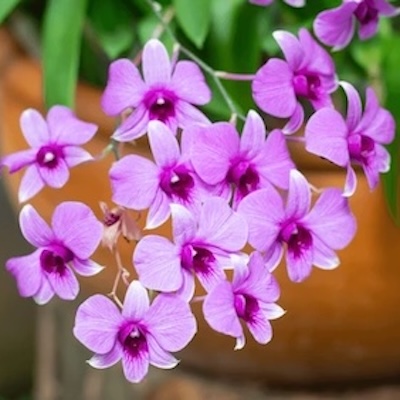
The Dendrobium Shangri-La on this note is not the same as another hybrid orchid called Dendrobium By Shangri-La, which was created much later in 2006 by Toh Garden, a tropical orchid grower in Singapore. Over the years, many Dendrobium hybrids have been registered and named after famous people and organisations. For example, Dendrobium Joseph Schooling and Dendrobium Yip Pin Xiu were named to honour these athletes’ achievements at the 2016 Rio Olympics and Paralympic Games. In addition, some Dendrobium species are used in Traditional Chinese Medicine (TCM). Known as 石斛 (shí hú), they have been valued for hundreds of years. Listed among the top ten herbs in classical TCM texts, they are believed to help nourish the body, strengthen important organs, and promote long life.
An Icon of Governance, Claimed and Reclaimed
Government Offices at St Andrew's Road
During the Japanese Occupation from 1942 to 1945, the government buildings along St Andrew’s Road, including the Supreme Court, were taken over by the Japanese military. The Supreme Court was used for military trials, while nearby government offices hosted public ceremonies to show and enforce Japanese control. When the war ended in 1945, this was the site where the Japanese officially surrendered to the British.
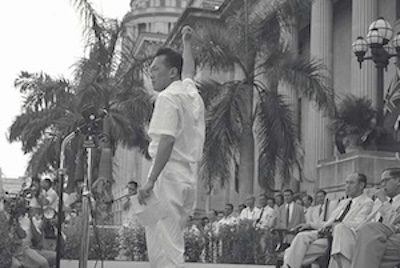
LKY Speaking at City Hall, 19576
Post-war, the main government building was renamed the City Hall when Singapore was officially granted city status by the British in 1951. Later, in 1959, it took on more historical significance as it was the venue from where Lee Kuan Yew declared Singapore’s self-governance from the British. It was also where he and his cabinet were sworn in as Singapore’s first self-governing government.
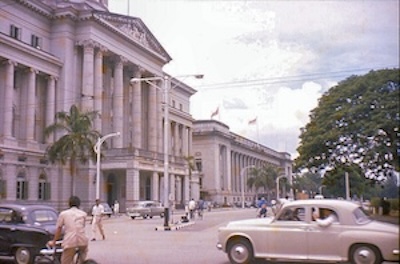
Supreme Court and City Hall in 19607
In the early 1960s, Singapore faced many problems. Unemployment was high, housing conditions were poor, and public health issues were common. The government also had to deal with political clashes between pro-communist and non-communist groups, as well as racial tensions that led to riots. At the same time, our economy was still dependent on entrepôt trade with little industrial base. With the future of self-governance uncertain and merger with Malaysia still in negotiation, government officials had to make tough decisions with limited resources and fragile public confidence.
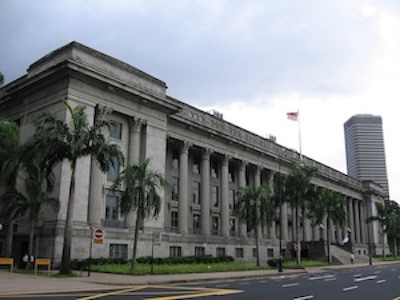
City Hall Building Today8
After Singapore attained our independence, there were debates about what to do with buildings like the City Hall and the Supreme Court. Some felt that they were relics of British colonialism and should no longer retain their functions; others argued that they represented stability and continuity for the administrative and legal systems. In the end, the buildings were preserved and continued to serve as iconic symbols of Singapore’s historical transition from a colony to an independent state.
Market Value in 2024
Market Price: $800
Condition
• Ungraded
• Well used
• No tears, pinholes or foxing
• Soft stains
• Visible creases & folds
Context
• The information here refers specifically to the banknote featured on the top of this page.
1. Prefix and banknote details from Vincent Tan and Tan Wei Jie, Singapore Banknotes: Complete Prefix Reference, Mr Banknotes, 2017.
2. Orchid registration details from International Orchid Register.
3. Image generated by ChatGPT using DALL·E (OpenAI), 2025. 4. Image from BioLib.cz. Source: https://www.biolib.cz/en/image/id284988/.
5. Image by @Joloei ID 347522035, Dreamtime.com . Source: https://www.dreamstime.com/beauty-purple-dendrobium-pompadour-orchid-hanging-tree-image347522035.
6. Image from If Only Singaporeans Stopped To Think. Source: https://ifonlysingaporeans.blogspot.com/2017/02/cia-closely-monitored-paps-struggles.html.
7. Image by Peter Forster, Wikipedia. Source: https://commons.wikimedia.org/wiki/File:SupremeCourt-CityHall-Singapore-196009.jpg.
8. Image by User:Sengkang, Wikipedia. Source: https://commons.wikimedia.org/wiki/File:City_Hall,_Singapore,_Jan_06.JPG.
Disclaimer
I built this website as a hobby, to share with others what I’ve learnt. All the information here is written based on my own research and understanding, and I don’t guarantee that everything is correct, complete, or updated. While I sell banknotes here, I don’t profit from them, as they are spare pieces from my private collection. All the banknote images here are taken by myself and they belong to me. The non-banknote images, with sources that I’ve attributed on every page, are used solely for illustration and non-commercial education purposes. If you are a copyright holder and believe something has been used inappropriately, please contact me, and I will immediately review or remove it.