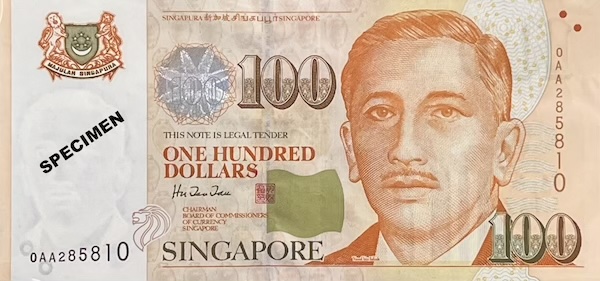
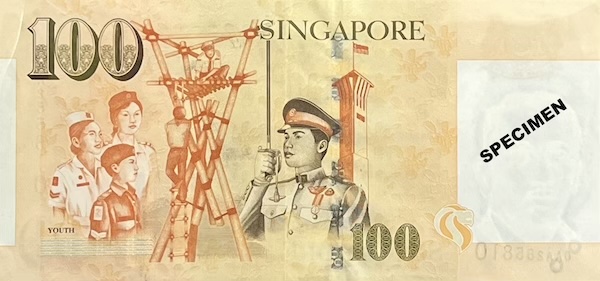
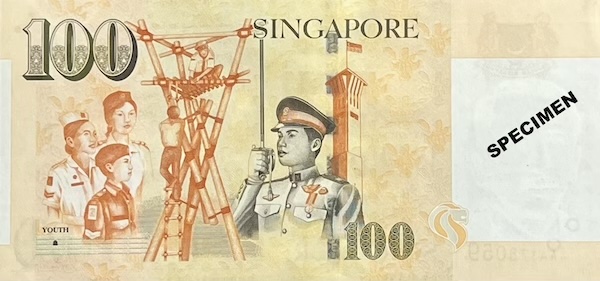
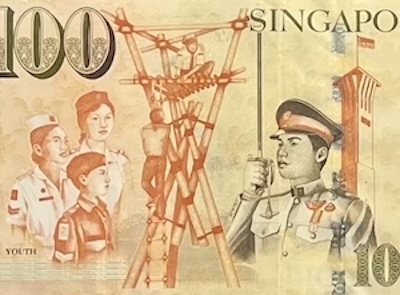
Our youths were the future stewards of our nation. Whether participating in uniformed groups or engaging in community projects, we saw them brim with energy and a sense of purpose. National Service, a rite of passage that transformed them into resilient young adults, further nurtured their character, infusing in them the values of discipline, leadership and civic duty. With our youths well prepared, they were now ready to take over the mantle and carry forward the ideals and values that built our nation.
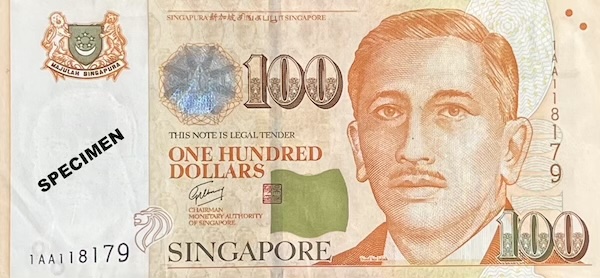
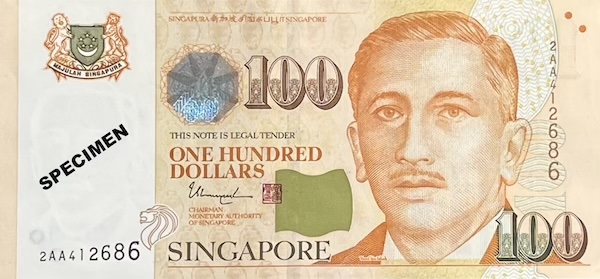
Circulation status: In circulation Issuing authority: • Prefixes 0AA to 0BF: BCCS • Prefixes 1AA onwards: MAS First issued: 9 September 1999 Pieces issued: Unknown
Printer: Thomas De La Rue & Co Ltd or Oesterreichische Banknoten- und Sicherheitsdruck GmbH (OeBS-Austria)
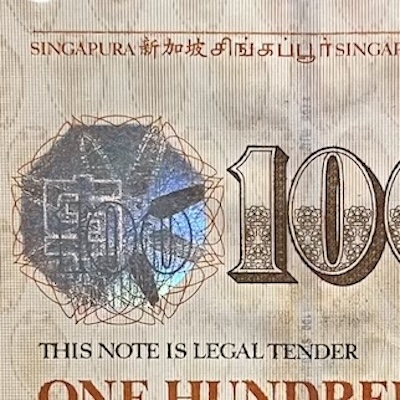
The $100 note stands out in the Portrait Series for several reasons. It is the highest denomination still being printed today, as the $1000 and $10000 notes have been stopped. With the discontinuation of these two notes, the Portrait $100 has also, together with the $50, become one of only two denominations that do not have a withdrawn version: the $2, $5, and $10 had paper versions that were replaced by polymer. The $100 note also has a unique signature history—its first batch was signed by then BCCS Chairman Hu Tsu Tau, and unlike the lower denominations which featured Lee Hsien Loong’s signature after that, the $100 did not. By the time the next batch was printed, Goh Chok Tong had taken over as Chairman and signed off the notes, making the $100 one of only two denominations—the other is the $1000—to show a direct transition from Hu Tsu Tau to Goh Chok Tong. The Portrait $100 is also the only note to use the bell—which resembles a house but with sloping sides—as a geometric shape on its back.
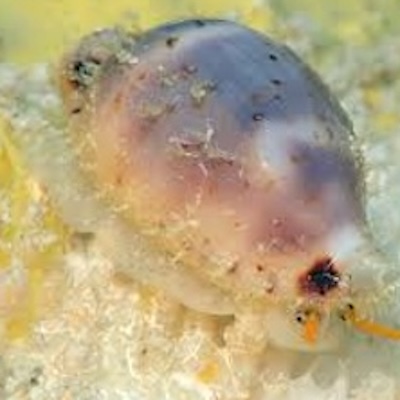
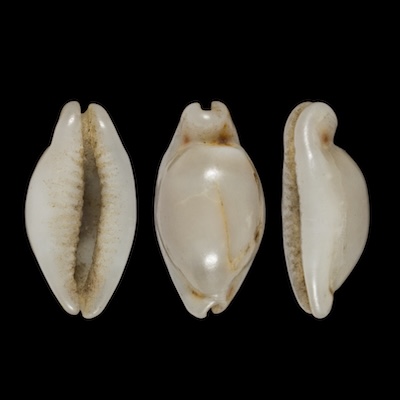
The Swallow Cowrie (Cypraea hirundo Linnaeus) is a small sea snail with a smooth, glossy shell marked with dark patterns that resemble a swallow in flight. It is found across the Indo-West Pacific region, including areas like Mauritius, India, Southeast Asia, and stretching as far as Japan and northwestern Australia. This cowrie typically lives in wave-swept reef areas during low tide, hiding under coral slabs and rocks. While it was originally named Cypraea hirundo by Carl Linnaeus in 1758, scientists later reclassified it under a more specific genus, and it is now known as Bistolida hirundo. Unlike other cowries that were widely used as currency, the Swallow Cowrie was not commonly used for trade. Instead, it is admired for its beauty and remains a favourite among shell collectors for its graceful form and striking patterns.
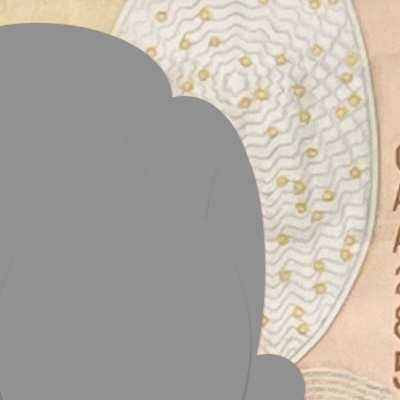
The Chinese peony (牡丹)—known as the ‘king of flowers’—has deep roots in Chinese history and tradition. During the Tang Dynasty, it was declared the national flower and widely cultivated in palace gardens, especially in the ancient city of Luoyang, which became known as the ‘City of Peonies’. So admired was the flower that nobles and scholars competed to grow the finest blooms. It often appeared in poetry and paintings as a symbol of elegance, refinement, and high status. People believed that a fully blooming peony brought luck, wealth, and prosperity. Its colours also carry special meanings—red symbolises honour and respect, pink represents romance and youth, and white stands for purity and peace. Even today, the peony remains a popular flower during festivals and weddings, where it expresses good wishes for happiness, harmony, and a successful future.
Growing Up The Singaporean Way
Youth
In the 1990s, Singaporean youth were growing up in a fast-changing world. This was the era of pagers, early mobile phones, and the arrival of the internet. They were among the first to experience global pop culture through MTV, computer games, and overseas holidays. At the same time, education became more competitive, with changes like the introduction of Normal and Express streams and a stronger focus on bilingualism. Despite the pressures—or perhaps because of them—this generation became known for their resilience and adaptability.
Officer Cadet School Commissioning Parade5
Uniformed groups like NCC, NPCC, Scouts, Red Cross, and St. John Ambulance Brigade have long been important platforms for developing leadership in young Singaporeans. They give students the chance to take on responsibilities, guide their peers, and make decisions under pressure. National Service also plays a key role, challenging young men to step up as commanders and role models in tough situations. These experiences help build confident, dependable leaders who carry those skills into their careers and communities.
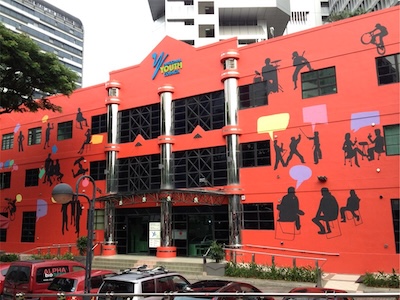
National Youth Council6
The National Youth Council (NYC) was set up in 1989 to help young people in Singapore grow, lead, and play a bigger role in the country’s future. It works to give youths a voice and supports them in becoming active and caring members of society. NYC runs programmes like Youth Corps Singapore, where youths can do volunteer work, and Young ChangeMakers, which gives support to young people with ideas to improve their community. It also holds Youth Conversations, where youths can share their views on national issues.
Singapore Youths7
Being young in Singapore today is not always easy. Youths feel pressure to do well in school, get a good job, and make their families proud—while also trying to figure out their own identities and what they believe in. Sometimes, they feel that older people cannot understand them, especially when it comes to things like career choices, social issues, or personal beliefs. Older folks sometimes say that youths today are too soft, get offended easily, refuse to work hard, or are overly emotional or rebellious. But deep down, most youths just want to be heard, understood, and supported as they grow and find their place in the world.
Market Value in 2024
Market Price: $150
Condition
• Ungraded
• Lightly used
• No tears, pinholes, stains or foxing
• Visible creases & folds
Context
• The information here refers specifically to the banknote featured on the top of this page.
1. Prefix and banknote details from Vincent Tan and Tan Wei Jie, Singapore Banknotes: Complete Prefix Reference, Mr Banknotes, 2017.
2. Image from Kwajalein Underwater. Source: http://www.underwaterkwaj.com/shell/cowry/Cypraea-hirundo.htm.
3. Image by Museum national d’Histoire naturelle. Source: https://commons.wikimedia.org/wiki/File:Bistolida_hirundo_(MNHN-IM-2000-9966).jpeg.
4. Image by Evgeniya Vlasova, The Spruce. Source: https://www.thespruce.com/paeonia-lactiflora-5095782.
5. Image by Ministry of Defence. Source: https://www.mindef.gov.sg/news-and-events/latest-releases/2016Jan17-News-Releases-01868.
6. Image by National Youth Council, Facebook. Source: https://www.facebook.com/nycsg/photos/a.10150102663945607/10151742538865607/?type=3&_rdr.
7. Image by National Youth Council. Source: https://www.nyc.gov.sg/.
Disclaimer
I built this website as a hobby, to share with others what I’ve learnt. All the information here is written based on my own research and understanding, and I don’t guarantee that everything is correct, complete, or updated. While I sell banknotes here, I don’t profit from them, as they are spare pieces from my private collection. All the banknote images here are taken by myself and they belong to me. The non-banknote images, with sources that I’ve attributed on every page, are used solely for illustration and non-commercial education purposes. If you are a copyright holder and believe something has been used inappropriately, please contact me, and I will immediately review or remove it.