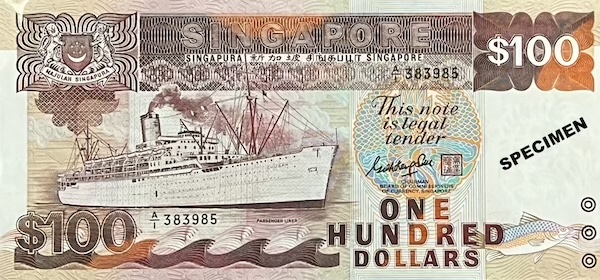
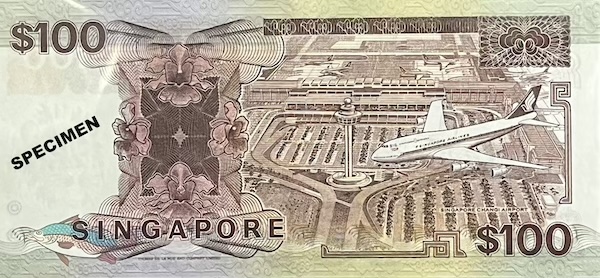
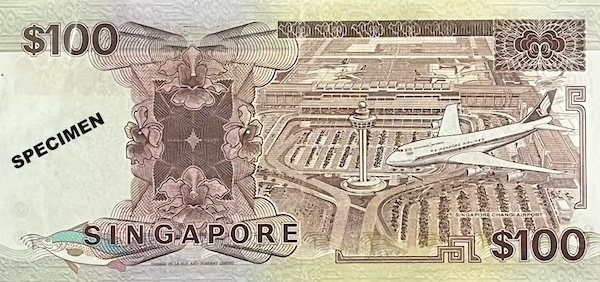
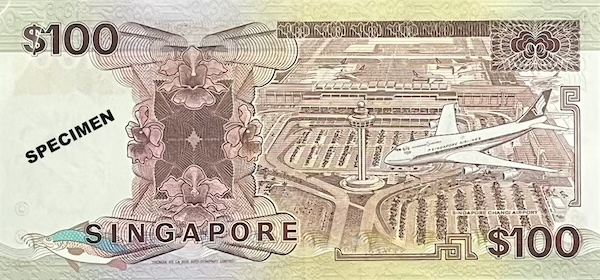
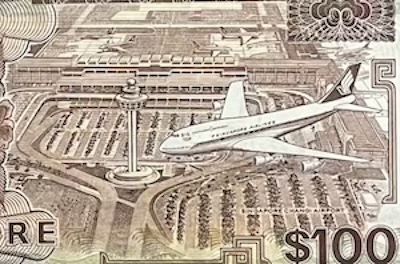
The completion of Changi Airport was another proud moment. With its sleek design, state-of-the-art facilities, and impressive scale, it was not merely a transit point, but a landmark that proved how a small nation could soar to the heights of global achievement. Travellers from afar witnessed at first hand our collective ambition and dedication in making our mark on the world. In turn, each flight that took off and landed offered us glimpses of the distant horizons, filling our hearts with wonder, excitement and purpose.
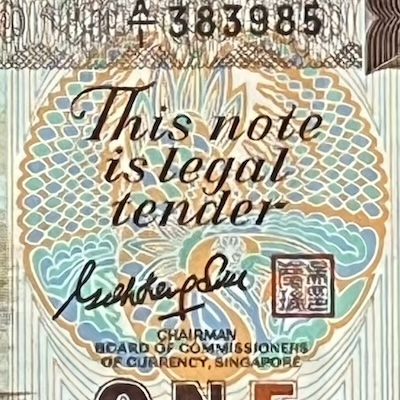
Signed by: Goh Keng Swee, Solid Security Thread (Front)
Signed by: Goh Keng Swee, Solid Security Thread (Back)
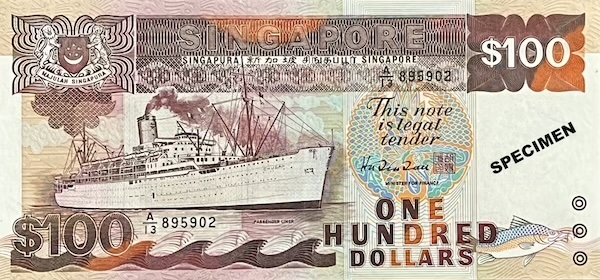
Signed by: Hu Tsu Tau, Solid Security Thread (Front)
Signed by: Hu Tsu Tau, Solid Security Thread (Back)
Signed by: Hu Tsu Tau, Segmented Security Thread (Front)
Signed by: Hu Tsu Tau, Segmented Security Thread (Back)
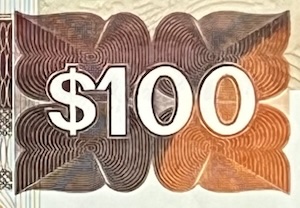
A New Look for the $100
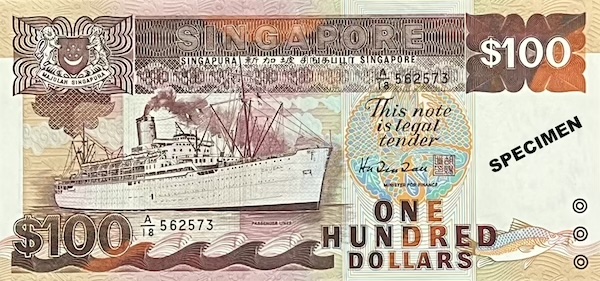
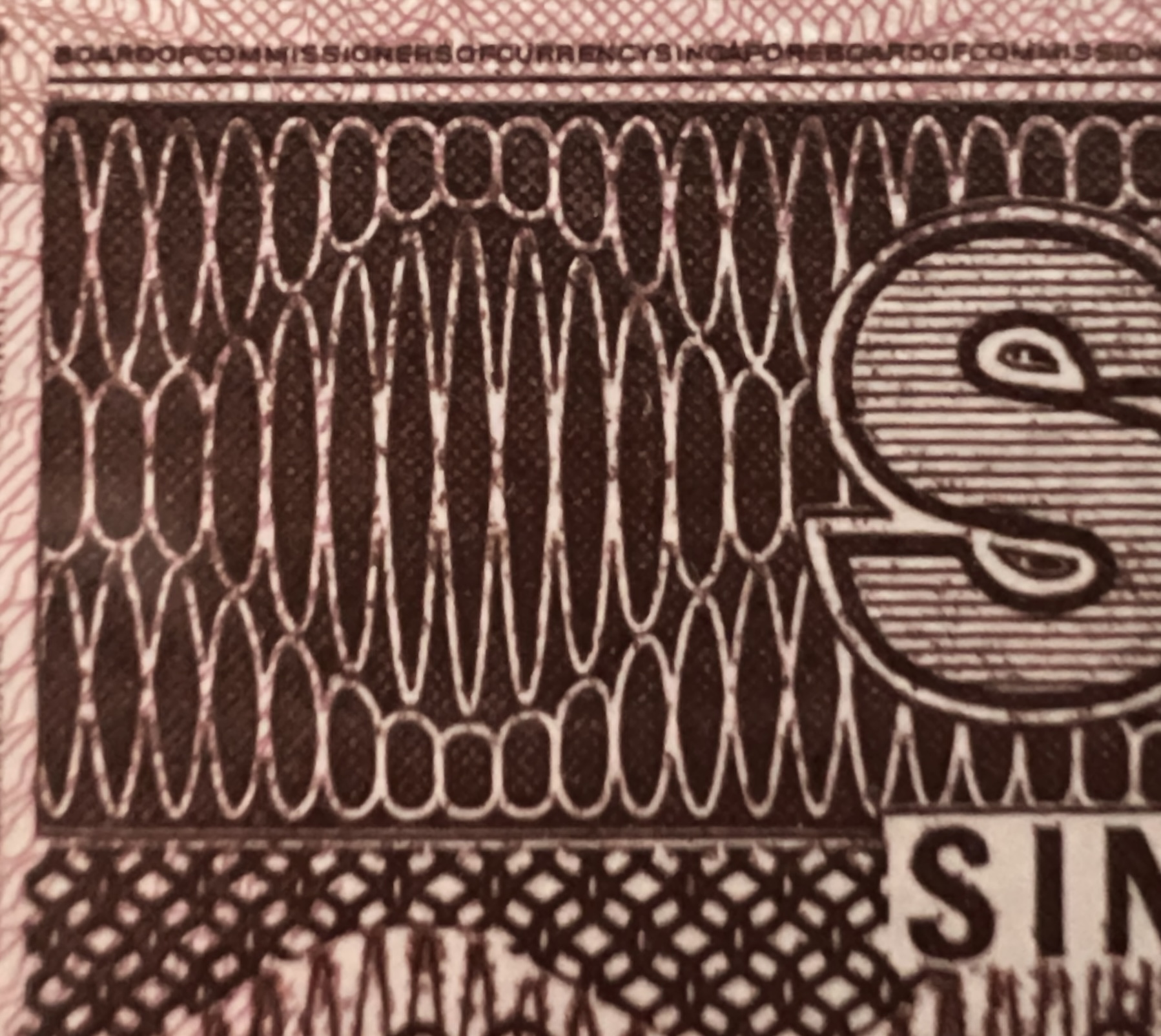
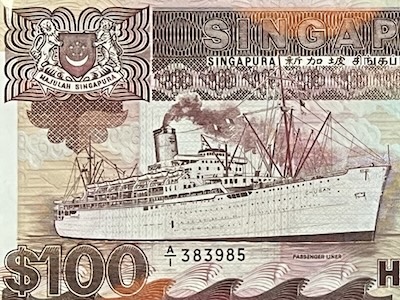
The Ship $100 note marked two significant firsts. It was the first $100 note to be printed in brown colour—unlike the earlier Orchid and Bird Series $100 notes, which were blue like the $50 notes, making it harder to tell the two apart. Singapore uses colour to help users easily identify different denominations, but brown couldn’t be used for the $100 note in the past because the $20 and $25 notes were already brown. With the discontinuation of those denominations in the Ship Series, brown was finally available, giving the $100 note a clearer identity. The Ship $100 was also the first—along with the $50 note in the same series—to feature micro-lettering, a new security feature where tiny words were printed on the note (above the word ‘SINGAPORE’). These words could only be seen under 10 to 20 times magnification, making the note harder to counterfeit.
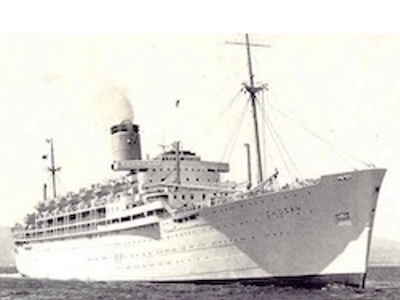
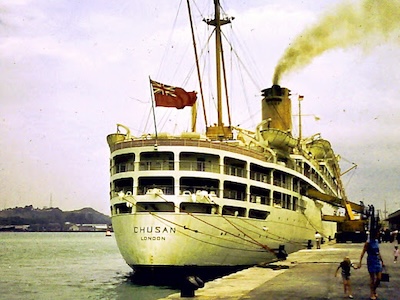
Before air travel became common, passenger liners were big ships that carried people across long distances by sea. These ships connected Singapore to faraway places like Europe, India, China, and Australia. They brought in traders, workers, families, and tourists, helping Singapore grow into a busy port and an important gateway in the region. One famous ship was the Chusan, a British passenger liner that often stopped in Singapore on its journey between the UK and Asia. It carried passengers, mail, and cargo, and was a familiar sight at our docks. Passenger liners like the Chusan played a big role in Singapore’s early years by bringing people, news, and goods that helped build our economy and connect us to the rest of the world.
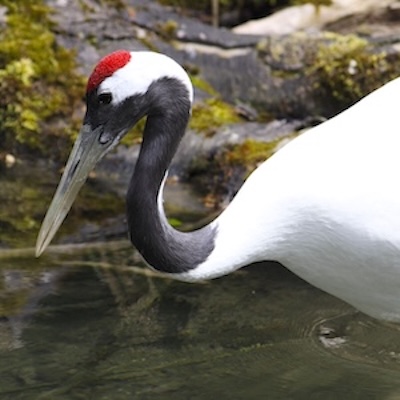
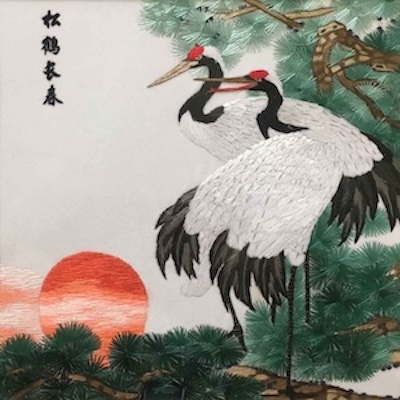
The most iconic crane in Chinese folklore is the red-crowned crane (丹顶鹤). It is the species featured on both the Ship $100 and Ship $1 notes. Known for its bright red patch on the head and elegant white feathers, the red-crowned crane brings to life the values of longevity, peace, and high status. In Taoist belief, the crane was said to carry immortals to the heavens, making it a powerful symbol of spiritual grace. Its red crown is seen as a sign of good fortune, while its noble appearance reflects wisdom and purity. Often seen in traditional Chinese paintings, the red-crowned crane is shown flying among clouds or beside pine trees—scenes that express the wish for a long, harmonious life.
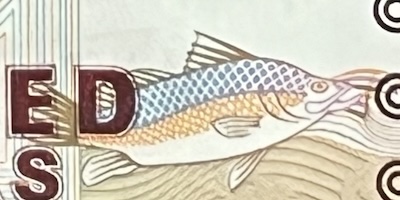
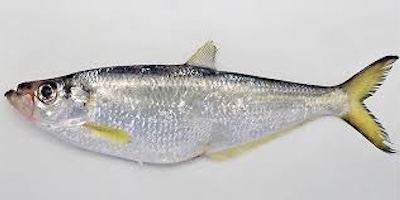
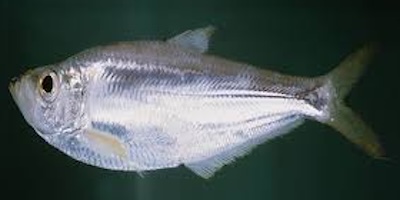
The Slender Shad is a well-known fish in Singapore, being a common and affordable choice at wet markets. Despite its name, it is not a true shad, and is more accurately described as a type of Chinese herring or long-jawed mackerel. With its soft, oily flesh and many fine bones, it was usually fried or braised in simple home-style dishes. While not seen as a luxury item, the slender shad was valued for its strong flavour and low cost, making it a staple on the dinner tables of many families. In 1980s Singapore, as households balanced between tradition and modernity, this fish became a symbol of modest comfort and practical living. Over the years, however, its popularity has declined, and it is now less frequently found in local markets. This shift may be due to changes in consumer preferences, availability of other fish species, and evolving culinary trends in Singapore.
Changi Airport: From One Terminal to World Class Icon
Changi Airport
Changi airport was opened in 1981. Replacing Paya Lebar, it quickly gained a reputation as a world-class airport. While it began as a single terminal and one runway, within a decade, it had a second terminal and two runways. By then, the airport was handling over 10 million passengers annually.
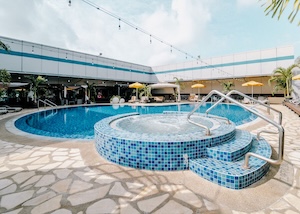
Changi Airport Swimming Pool8
From day one, Changi Airport prioritised travellers’ experience, introducing features like lush greenery, spacious lounges, and duty-free shopping, which set it apart from other airports. In the 1990s, it added interactive entertainment zones to further enhance the passenger experience. The airport also offered unique amenities, including a butterfly garden, a rooftop swimming pool, and free movie theatres. In 2019, it opened the Jewel, a multi-use complex featuring over 280 retail and dining outlets, and attractions like the HSBC Rain Vortex, the world’s tallest indoor waterfall.
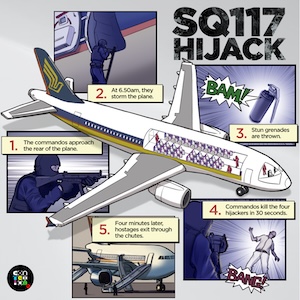
Rescue Operation in SQ 117 Hijack9
Since its inauguration, Changi Airport has maintained an exemplary safety record, with only a few notable incidents. One significant incident was the hijacking of Singapore Airlines Flight 117 in 1991. On 26 March 1991, the SIA flight was hijacked by four Pakistani militants en route from Kuala Lumpur to Singapore. The hijackers demanded the release of political prisoners in Pakistan. After landing at Changi Airport, troopers from Singapore’s Special Operations Force stormed the aircraft, successfully rescuing all 118 passengers and 11 crew members without any casualties, while killing all four hijackers.
Market Value in 2024
Market Price: $140
Condition
• Ungraded
• Well used
• No tears, pinholes, stains or foxing
• Visible creases & folds
Context
• The information here refers specifically to the banknote featured on the top of this page.
1. Prefix and banknote details from Vincent Tan and Tan Wei Jie, Singapore Banknotes: Complete Prefix Reference, Mr Banknotes, 2017.
2. Image from pandosno.co.uk. Source: https://www.pandosnco.co.uk/chusan.html.
3. Image from 35mmMan, Flickr. Source: https://www.flickr.com/photos/35mmman/8353318300.
4. Image from WildArk. Source: https://wildark.org/species/red-crowned-crane/.
5. Image from ImportItAll listing. Source: https://www.importitall.co.za/Silk-Art-Handmade-Framed-Silk-Embroidery-13X13-inch-Redcrowned-Crane–Pine-Tree–Sun-Painting-Oriental-Wall-Ha-ap-B01H9Z87QC.html.
6. Image by Lai, N.-W. Source: https://www.fishbase.se/summary/Ilisha-elongata.
7. Image by Randall, John E. Source: https://marinebiodiversity.org.bd/species/ilisha-elongata/.
8. Image from Changi Airport Group. Source: https://nowboarding.changiairport.com/discover-changi/luxury-amenities-in-singapore-changi-airport.html.
9. Image from SG101-Nexus, Ministry of Defence. Source: https://www.sg101.gov.sg/resources/connexionsg/onthisday-sq117-hijack/
Disclaimer
I built this website as a hobby, to share with others what I’ve learnt. All the information here is written based on my own research and understanding, and I don’t guarantee that everything is correct, complete, or updated. While I sell banknotes here, I don’t profit from them, as they are spare pieces from my private collection. All the banknote images here are taken by myself and they belong to me. The non-banknote images, with sources that I’ve attributed on every page, are used solely for illustration and non-commercial education purposes. If you are a copyright holder and believe something has been used inappropriately, please contact me, and I will immediately review or remove it.